
Your restaurant's break-even point is the day you stop losing money and start making it. Most restaurants take 6-12 months to reach break-even. Some never do.
⚠️ Disclaimer: This guide provides educational information about break-even analysis and is not financial advice. Results are estimates based on the inputs you provide. Consult with a qualified accountant or financial advisor for your specific situation.
🔢 Try the Interactive Calculator: This guide explains the math behind break-even analysis. When you're ready to run your own numbers, use our free break-even calculator →
I met an owner in Denver who'd been open for 2 years and had never broken even. Not once. Not a single month. He was losing $8,000 a month and funding it with a HELOC on his house. When I asked him what his break-even number was, he said "I don't know. I just need more customers." He needed 92 covers a day. He was doing 64. More customers wouldn't have helped. He needed 44% more customers. That's not a marketing problem. That's a concept problem.
Knowing your break-even number before you open tells you whether your concept works on paper. Here's how to calculate it and what to do with the number.
Industry Data & Sources:
Bureau of Labor Statistics data shows the restaurant industry employs over 12.5 million people with annual turnover rates around 75%.
The National Restaurant Association provides operational benchmarks and best practices for restaurant management.
What is the Restaurant Break-Even Formula?
Break-even is the revenue level where your total costs equal your total revenue. Below break-even, you lose money. Above break-even, you make money. It's the most important number in your business plan and the one most owners can't tell you.
Where:
- Fixed Costs = Expenses that don't change with sales volume (rent, insurance, manager salaries, loan payments)
- Contribution Margin Ratio = What's left from each dollar of sales after paying variable costs (food cost, hourly labor, credit card fees)
Example: If your fixed costs are $18,500/month and your contribution margin ratio is 40.5% (0.405), your break-even is $18,500 ÷ 0.405 = $45,679/month.
How to Calculate Your Break-Even Point
Recommended Tool
Track your inventory in real-time and reduce food waste with MarketMan.
Used by 2,400+ restaurants to optimize their purchasing.
Step 1: Calculate Your Fixed Costs
Add up everything you pay regardless of how busy you are:
Rent: $6,000 per month Insurance: $800 per month Manager salaries: $7,000 per month Loan payments: $2,000 per month Software subscriptions: $500 per month Marketing (base): $500 per month Utilities (base): $1,200 per month Maintenance (base): $500 per month
Total fixed costs: $18,500 per month
Step 2: Calculate Your Contribution Margin
For every dollar of revenue, subtract your variable costs:
Food cost: 30% (30 cents per dollar) Hourly labor: 25% (25 cents per dollar) Credit card fees: 2.5% (2.5 cents per dollar) Supplies: 2% (2 cents per dollar)
Total variable costs: 59.5 cents per dollar Contribution margin: 40.5 cents per dollar (40.5%)
Step 3: Calculate Break-Even Revenue
$18,500 / 0.405 = $45,679 per month
This restaurant needs $45,679 in monthly revenue to break even. At a $25 average ticket, that's 1,827 covers per month or 61 covers per day (assuming open 30 days). At a $40 average ticket, that's 1,142 covers per month or 38 covers per day.
Step 4: Reality Check
Can you do 61 covers per day at $25 per ticket? If you have 50 seats and do 1.2 turns per day, yes. If you have 30 seats and do 1 turn per day, no. Your concept doesn't work at this rent level.
Use our break-even calculator to run these numbers for your specific situation.
The Denver owner? His fixed costs were $24,000 a month. His contribution margin was 35%. Break-even: $68,571. He had 40 seats. At $35 average ticket, he needed 49 covers a day at 1.2 turns. He was doing 1.6 turns but his average ticket was only $28 because he'd been discounting to attract customers. The discounts were making his problem worse. Every discounted meal lost money. He was digging the hole deeper trying to climb out.
Case Study: Mike's Pizzeria
Let's walk through a real-world example so you can see how break-even analysis works in practice.
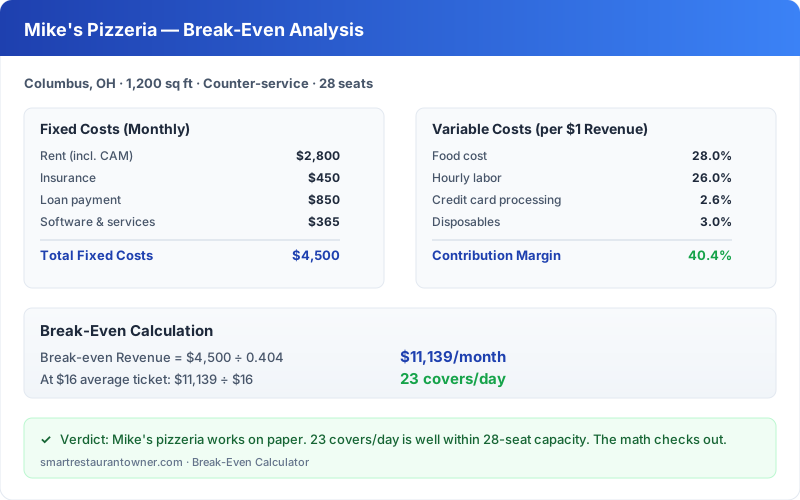
Mike leased a 1,200 sq ft space in a strip mall in Columbus, Ohio. He's opening a counter-service pizzeria selling 12-inch personal pizzas, salads, and drinks. Here are his numbers.
Mike's Fixed Costs (Monthly)
| Expense | Amount |
|---|---|
| Rent (including CAM) | $2,800 |
| Insurance | $450 |
| Manager salary (himself) | $0 (first year) |
| Loan payment (equipment loan) | $850 |
| POS software | $60 |
| Internet & phone | $150 |
| Pest control | $75 |
| Music licensing | $45 |
| Accounting software | $35 |
| Total Fixed Costs | $4,465 |
Mike's fixed costs are low because he's not paying himself a salary in year one and his rent is reasonable for a strip mall location. Let's round to $4,500 for easy math.
Mike's Variable Costs (Per Dollar of Revenue)
| Cost | Percentage |
|---|---|
| Food cost (dough, cheese, toppings) | 28% |
| Hourly labor (2 cooks, 1 cashier) | 26% |
| Credit card processing | 2.6% |
| Disposables (boxes, napkins, cups) | 3% |
| Total Variable Costs | 59.6% |
| Contribution Margin | 40.4% |
Mike's Break-Even Calculation
Break-even revenue = $4,500 / 0.404 = $11,139 per month
At Mike's average ticket of $16 (pizza + drink), he needs:
$11,139 / $16 = 696 covers per month, or 23 covers per day (open 30 days).
The Reality Check
Mike has 28 seats and is open 11am-9pm (10 hours). At 23 covers per day, he needs less than 1 table turn. That's extremely achievable. Even on a slow Tuesday with 15 covers, he's still covering his variable costs and most of his fixed costs.
Pro Tip: Mike's break-even is low because he's not paying himself. If he paid himself a $4,000 monthly salary, his fixed costs jump to $8,500 and his break-even becomes $21,040 — or 44 covers per day. That's still doable at 1.6 turns, but it's not automatic. Always run your break-even with and without your own salary. You need to know when the business can afford to pay you.
What Happens If Mike Raises Prices?
Mike's $12 pizza is priced at the market average. If he raises it to $13 (an 8.3% increase) and his food cost stays at $3.36 per pizza:
New average ticket: $17. Food cost percentage drops from 28% to 26.4%. Contribution margin improves from 40.4% to 42%.
New break-even: $4,500 / 0.42 = $10,714. That's $425 less revenue needed per month, or 21 covers per day instead of 23.
Pro Tip: A small price increase has an outsized impact on your break-even because it improves your contribution margin on every single sale. Before you try to cut costs, try raising prices by 5-8%. Most customers won't notice. Your break-even will.
What Happens If Food Costs Spike?
Cheese prices jumped 22% in 2025. If Mike's food cost goes from 28% to 32%, his contribution margin drops to 36.4%.
New break-even: $4,500 / 0.364 = $12,363. He now needs 26 covers per day instead of 23. That's still manageable, but his margin for error shrinks.
Pro Tip: Run your break-even at three food cost levels: your current cost, +5%, and +10%. If a 10% food cost increase pushes your break-even above what your seating capacity can support, you have a fragile business model. Mike's pizzeria survives a 10% food cost spike. Many restaurants don't.
Mike's Takeaway
Mike's pizzeria works on paper. His break-even of 23 covers per day is well within his 28-seat capacity. He can survive food cost spikes, slow Tuesdays, and even start paying himself once he's consistently doing 40+ covers per day. The math checks out.
Compare this to the Denver owner from earlier: $24,000 in fixed costs, 35% contribution margin, 40 seats. He needed 49 covers per day at 1.2 turns. His concept was mathematically broken from day one. Mike's isn't.
Run your own numbers with our break-even calculator before you sign a lease. Mike did. The Denver owner didn't. One of them is still in business.
Pro Tip: If you're in the planning phase, read our how to open a restaurant guide for a complete 12-month timeline, real cost breakdowns, and the mistakes that kill most new restaurants before they open.
Fixed vs Variable: The Gray Areas
Some costs are semi-variable. They have a fixed component and a variable component.
Labor: Your manager salary is fixed. Your hourly cooks and servers are variable. But you need a minimum number of hourly staff to open the doors, even if you have zero customers. That minimum staffing is effectively a fixed cost.
📬 Get More Customers. Get More Profit.
Join 2,400+ restaurant owners getting actionable tips every Friday. One email. One insight. No spam.
Utilities: Your base electricity (refrigeration, lights) is fixed. Your cooking gas varies with volume. Split utilities 60% fixed, 40% variable for a typical restaurant.
Marketing: Your website and basic listings are fixed. Your ad spend should vary with revenue. Split marketing 50% fixed, 50% variable.
Don't overthink this. If you're off by 5% on your utility split, your break-even moves by maybe $500. The point is to get close enough to know if your concept works. The Denver owner didn't need a perfect break-even calculation. He needed to know he was $24,000 short every month.
How to Lower Your Break-Even Point
Reduce Fixed Costs
Renegotiate your rent. A 10% reduction from $6,000 to $5,400 lowers your break-even from $45,679 to $44,198. That's $1,481 less revenue you need every month.
Pro Tip: The best time to negotiate rent is before you sign the lease, not after. Ask for 2-3 months of free rent during build-out, a tenant improvement allowance of $20-50 per square foot, and a cap on CAM (common area maintenance) increases. Landlords would rather give you concessions upfront than have a vacant space in 12 months. Read our how to open a restaurant guide for more lease negotiation tactics.
Refinance your loans. A 2% rate reduction on a $200,000 loan saves $4,000 per year in interest. That's $333 per month in lower fixed costs.
Cut subscriptions you don't use. That $79/month scheduling software you never set up properly. The $29/month music service you forgot about. The $49/month reservation system nobody uses. That's $157 per month in found money.
I did a subscription audit for a restaurant group once. Found $1,100 a month in unused software. They'd signed up for trials, forgotten to cancel, been paying for years. One was a $199/month "reputation management" tool that had never been logged into. Not once. They'd paid $7,164 for it over 3 years.
Increase Contribution Margin
Raise prices. A 5% price increase with no change in food cost improves your contribution margin. If your $25 average ticket becomes $26.25 and food cost stays at $7.50, your contribution margin goes from 40.5% to 42.9%. Break-even drops from $45,679 to $43,124.
Reduce food cost. A 2% reduction from 30% to 28% improves contribution margin to 42.5%. Break-even drops to $43,529.
Pro Tip: Most restaurants can shave 2-3% off food cost without changing their menu. Negotiate with 2-3 suppliers instead of using one. Buy proteins in bulk and portion them in-house. Track waste for two weeks — you'll find at least 1% in food you're throwing away. Use our food cost calculator to see exactly how much each percentage point saves you.
Reduce credit card fees. Switching from 2.6% to 2.3% processing saves 0.3% on every dollar. On $45,679 in monthly revenue, that's $137 per month. Small, but it adds up.
Break-Even by Concept Type
A food truck with $5,000 in fixed costs and a 45% contribution margin needs $11,111 a month to break even. That's 15 covers a day at $25. Doable.
A QSR with $15,000 in fixed costs and 42% margin needs $35,714. That's 48 covers a day. Tight but possible.
A fast casual with $18,000 fixed and 40% margin needs $45,000. That's 60 covers a day. You need a good location and solid operations.
A full-service restaurant with $25,000 fixed and 38% margin needs $65,789. That's 88 covers a day at $25. You need 50+ seats and 1.5+ turns. This is where most restaurants fail. They sign a lease on a $25,000 fixed cost structure and can't hit 88 covers a day.
Fine dining with $40,000 fixed and 35% margin needs $114,286. At a $75 ticket, that's 51 covers a day. The math works but the fixed costs are terrifying. One slow month and you're $30,000 in the hole.
Pro Tip: Your concept determines your break-even before you serve a single customer. A food truck with $5,000 fixed costs can survive almost anything. A fine dining restaurant with $40,000 fixed costs has zero margin for error. Pick a concept whose break-even math works at your funding level. If you can only raise $100,000, don't open a concept that needs $114,286 a month to break even. Use our menu price optimizer to model different concept scenarios before you commit.
When to Worry About Your Break-Even
If your break-even is more than 80% of your projected revenue, you have no margin for error. A slow month puts you in the red. You need to either reduce fixed costs, increase contribution margin, or accept that you'll lose money in slow months.
If your break-even requires more covers per day than your seating capacity times your realistic turns, your concept doesn't work. A 50-seat restaurant doing 1.5 turns needs 75 covers to break even. If your break-even is 100 covers, you need 2 turns. Can you do 2 turns every night? If not, your concept doesn't work at this rent level.
If your break-even timeline is more than 18 months, you're undercapitalized. You need enough cash to cover losses until you hit break-even. If you're losing $10,000 per month and break-even is 18 months away, you need $180,000 in working capital just to survive.
Pro Tip: Most new owners underestimate their break-even timeline by 6-12 months. Whatever your spreadsheet says, add 50%. If your projection shows break-even at month 8, plan for month 12. The extra 4 months of working capital is the difference between closing in month 10 and surviving to profitability. For a complete startup budget and timeline, see our how to open a restaurant guide.
The Denver owner? He closed 4 months after we met. He'd burned through $190,000 in HELOC money. His landlord wouldn't renegotiate the lease. His concept couldn't support the rent. The math never worked. He just didn't do the math before he signed the lease.
Do the math. Use our break-even calculator. Know your number before you sign anything.
Related: Restaurant Profit Margin · Food Cost Percentage · Restaurant Business Plan
Recommended Tool
Streamline your inventory management with MarketMan.
Get real-time tracking, automated ordering, and waste reduction.