
A restaurant owner in Chicago showed me his monthly third-party delivery statement. Uber Eats: $4,200 in commissions on $14,000 in orders (30%). DoorDash: $3,800 on $12,700 (29.9%). Grubhub: $2,100 on $7,200 (29.2%). Total: $10,100 in commissions on $33,900 in orders. He was paying 29.8% of his delivery revenue to platforms that owned his customer data.
He switched to Toast Online Ordering for direct orders through his website. The setup cost $1,200. The monthly fee is $75. The processing rate is 2.49% + 15 cents. On the same $33,900 in monthly orders, his cost dropped to $844 in processing plus $75 in software. Total: $919. He saved $9,181 a month. $110,172 a year. He used the savings to hire a dedicated delivery driver at $18/hour, which cost him $37,440 a year. Net savings after the driver: $72,732.
Third-party delivery platforms are a customer acquisition channel, not an ordering system. You pay 15-30% commissions to access their customer base. For orders from your own customers who find you through Google or your social media, you should pay 0% commission plus processing. Here's how the direct ordering systems compare.
The Commission Problem
Third-party delivery platforms charge 15-30% per order. The rate depends on your negotiation, your volume, and whether you use their delivery drivers. Marketing orders (customers who find you through the platform) cost 15-20%. Delivery orders (platform provides the driver) cost 25-30%. The blended rate for most independent restaurants is 20-28%.
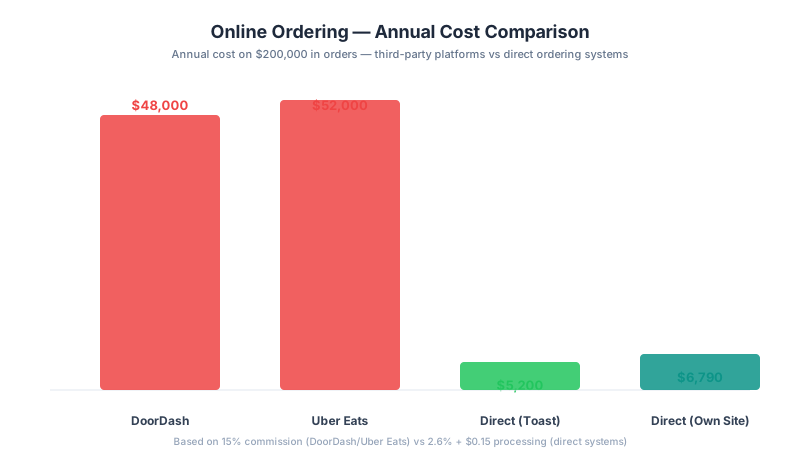
On $200,000 in annual online orders, that's $40,000-$56,000 in commissions. A direct ordering system costs $900-$3,600 a year in software plus 2.5-2.9% in payment processing. On the same $200,000, that's $5,000-$5,800 in processing plus $900-$3,600 in software. Total: $5,900-$9,400. Savings versus third-party: $30,600-$50,100 a year.
The catch: you have to drive customers to your direct ordering channel. The platforms bring customers. Your website doesn't. You need to invest in marketing to make direct ordering work. But even if you spend $10,000 a year on social media ads driving customers to your direct ordering page, you're still saving $20,600-$40,100.
The Four Direct Ordering Systems
Recommended Tool
Track your inventory in real-time and reduce food waste with MarketMan.
Used by 2,400+ restaurants to optimize their purchasing.
| Toast Online Ordering | Square Online | Popmenu | ChowNow | |
|---|---|---|---|---|
| Monthly Fee | $75-$150 | $0-$72 | $199-$399 | $99-$149 |
| Setup Fee | $500-$1,500 | $0 | $500-$1,000 | $0-$299 |
| Processing Rate | 2.49% + 15¢ | 2.6% + 10¢ | 2.9% + 30¢ | 2.49% + 20¢ |
| POS Integration | Native (Toast) | Native (Square) | 40+ POS systems | 30+ POS systems |
| Custom Branding | Yes | Yes | Yes | Yes |
| Marketing Tools | Basic | Basic | Advanced | Basic |
| Loyalty Program | Yes | Yes | Yes | No |
| Best For | Toast restaurants | Square restaurants | Marketing-focused | Budget-conscious |
According to the National Restaurant Association's 2026 State of the Industry report, 70% of restaurant operators say third-party delivery commissions are their top cost concern. Toast Online Ordering processes direct orders for over 100,000 restaurant locations with native POS integration. Square Online offers a free tier with no monthly fee, making it the lowest-cost entry point for direct ordering. Popmenu combines website, online ordering, and marketing automation for restaurants. ChowNow pioneered commission-free online ordering and maintains a diner marketplace for restaurant discovery. The FTC's 2024 report on delivery platform practices found that third-party platforms charge restaurants 15-30% per order, with the average independent restaurant paying 24% in blended commissions.
Toast Online Ordering: Best for Toast Users
Toast Online Ordering integrates natively with Toast POS. Orders from your website flow directly into your kitchen display system. No tablet. No manual entry. The menu syncs automatically. When you 86 an item in Toast, it disappears from your online menu in real time. This alone prevents 2-3 "sorry we're out of that" calls per week.
The ordering interface is clean and fast. Customers can reorder their last meal in 3 taps. The loyalty program integrates with online ordering: customers earn and redeem points whether they order online or in-person. The data lives in your Toast dashboard alongside your in-person sales data.
The downside: Toast Online Ordering only works with Toast POS. If you're on Square or Clover, you can't use it. The setup fee of $500-$1,500 is higher than Square's $0. The monthly fee of $75-$150 is higher than Square's $0-$72. But the integration quality justifies the premium.
Square Online: Best for Square Users (and Free Tier)
Square Online has a free tier. You pay 2.6% + 10 cents per transaction. No monthly fee. No setup fee. For a restaurant doing $100,000 a year in online orders, that's $2,600 in processing. Total cost: $2,600. Toast would cost $900-$1,800 in software plus $2,490 in processing. Total: $3,390-$4,290. Square is $790-$1,690 cheaper.
The free tier includes online ordering, curbside pickup management, and basic loyalty. The paid tier ($72/month) adds custom domain, removed Square branding, and advanced loyalty. For most independent restaurants, the free tier is enough.
Square Online's weakness: the ordering interface is less restaurant-optimized than Toast's. The menu layout is more retail than food service. The customization options are limited. But it works. Orders flow into your Square POS. The integration is native. For the price (free), it's hard to beat.
Popmenu: Best for Marketing-Driven Restaurants
Popmenu is a website and online ordering platform built specifically for restaurants. It costs $199-$399 a month, which is 2-5x more than Toast or Square. The premium buys you marketing tools that the others don't have: automated email campaigns to lapsed customers, dynamic menu pages with professional food photography, AI-powered dish descriptions, and review management.
Popmenu's online ordering is solid but not better than Toast's. The value is in the marketing. If you're spending $500-$1,000 a month on marketing anyway, Popmenu consolidates your website, online ordering, and marketing into one platform. The $199-$399 monthly fee replaces your website cost, your ordering system cost, and some of your marketing cost.
Popmenu integrates with 40+ POS systems, so you're not locked into one POS. The integration is through middleware, which adds a slight delay (5-15 seconds) between when an order is placed and when it appears in your kitchen. For most restaurants, this is unnoticeable. For high-volume operations, it's a consideration.
ChowNow: Best Budget Option
ChowNow costs $99-$149 a month with no per-order commission. The platform builds you a branded ordering page and mobile app. Orders flow into a ChowNow tablet or integrate with your POS (30+ systems supported). The processing rate is 2.49% + 20 cents.
ChowNow's advantage: they offer a commission-free marketplace where customers can discover your restaurant. It's not as large as DoorDash or Uber Eats, but it's growing. Orders through the marketplace still have no commission. You pay the monthly fee and processing. That's it.
ChowNow's disadvantage: the ordering interface is less polished than Toast or Square. The customization options are limited. The POS integration is through middleware, not native. For a budget-conscious restaurant that wants to escape third-party commissions, ChowNow is the cheapest path.
The Direct Ordering Strategy
Step 1: Set up a direct ordering system on your website. Toast Online Ordering if you're on Toast. Square Online if you're on Square. Popmenu if you want the marketing tools.
Step 2: Put a QR code on every table, every receipt, and every takeout bag that links to your direct ordering page. The QR code should say "Order Direct & Save" or "Skip the Fees. Order Here." Customers who find you through the QR code order direct next time.
Step 3: Run social media ads driving customers to your direct ordering page, not to third-party platforms. A $500 Facebook ad campaign that generates 50 direct orders saves $150-$250 in commissions versus those same orders coming through DoorDash. The ad pays for itself in 2-3 months.
Step 4: Keep one third-party platform for customer acquisition. Don't cancel all of them. You need the discovery. But push your existing customers to direct ordering. The goal is 60-70% direct orders, 30-40% third-party. Most restaurants are at 10-20% direct, 80-90% third-party. Flipping that ratio saves $30,000-$80,000 a year.
For more on restaurant technology, see our Toast vs Square vs Clover comparison and our restaurant POS buying guide. Run your delivery economics through our restaurant break-even calculator. For marketing your direct ordering channel, see our restaurant marketing plan guide.
My Recommendation
For Toast users, buy Toast Online Ordering. The native integration prevents menu sync errors and saves 2-3 hours a week in manual order entry. The $75-$150 monthly fee is worth the integration quality.
For Square users, use Square Online free tier. It costs nothing beyond processing. The interface is adequate. The integration is native. Upgrade to the paid tier ($72/month) when you want custom branding.
For restaurants spending $500+ a month on marketing, consider Popmenu. The consolidated platform replaces your website, ordering system, and some marketing tools. The $199-$399 monthly fee is competitive when you factor in what you're already spending.
For budget-conscious restaurants on any POS, ChowNow at $99-$149 a month is the cheapest way to escape third-party commissions. The interface isn't as polished, but it works. For delivery management, see our restaurant delivery guide.
A Warning About Canceling Third-Party Platforms Too Quickly
A restaurant in Nashville switched to direct online ordering and canceled their DoorDash and Uber Eats accounts on the same day. They were tired of paying 28% commissions. They put QR codes on every table and receipt. They told customers to order direct. After 4 weeks, their online orders dropped from 180 a week to 47. The QR codes worked for dine-in customers who saw them. They didn't work for the 60% of their delivery customers who discovered the restaurant through the platform apps. Those customers had never been to the restaurant. They didn't have a QR code. The owner had no way to reach them. He spent 6 weeks rebuilding the relationship with DoorDash and reactivating the account. During those 6 weeks, he lost about $18,000 in delivery revenue.
Direct ordering replaces orders from customers who already know you. It doesn't replace customer acquisition. Keep at least one third-party platform active for discovery. Push existing customers to direct ordering. Let the platforms bring you new ones.
Hidden Fees & Implementation Traps
What are the hidden integration and middleware costs?
Popmenu and ChowNow integrate with your POS through middleware providers like MenuLink or Omnivore. These middleware fees aren't included in the quoted monthly price. Expect $50 to $150 per month per location for the integration layer. A 2-location restaurant on Popmenu at $299/month pays an additional $100/month for middleware — a 33% increase on the quoted price. Toast and Square users avoid this because integration is native. Ask every vendor: "Does your quoted price include all POS integration fees, or are there third-party middleware costs?" If they hesitate, the answer is yes.
Who owns the customer data in a direct ordering system?
Toast and Square own the customer data collected through their ordering platforms. You can access it within their ecosystem, but exporting it requires manual work. If you cancel your Toast Online Ordering subscription, you lose access to the customer list and order history. A restaurant in Seattle that left Toast for another POS couldn't export their 4,200-person email list from Toast Online Ordering. They had to rebuild it from scratch over 6 months, costing an estimated $4,200 in lost reorder revenue from customers they couldn't reach. Square's data portability is slightly better — you can export customer emails as a CSV — but order history stays in Square's system. Before committing to any platform, confirm in writing that you can export your customer database at any time, including after cancellation.
What do chargeback fees look like for online orders?
Online orders have higher chargeback rates than in-person transactions because the card isn't physically present. Toast charges $25 per chargeback. Square charges $15. Popmenu passes through the processor's chargeback fee, typically $20 to $30. For a restaurant doing 200 online orders a week, expect 1 to 2 chargebacks per month from customers who claim they didn't receive the order or didn't authorize it. At $25 each, that's $300 to $600 a year in unadvertised fees. The real cost is the time spent disputing them: 20 to 30 minutes per chargeback gathering delivery confirmation, order details, and customer communication. At $18/hour for a manager's time, that's another $200 to $300 a year.
Are there marketing add-on costs that aren't included in the base price?
Popmenu's $199-$399/month includes basic marketing tools, but the advanced features cost extra. Automated email campaigns to lapsed customers, A/B testing on menu pages, and premium food photography are additional. Expect $50 to $150 per month for the marketing add-on tier. Square Online's paid tier ($72/month) removes Square branding but doesn't include email marketing — that's a separate $15/month for Square Marketing. Toast's marketing tools are basic at the base tier; email campaigns require a separate $50/month add-on. A restaurant on Popmenu paying $299/month for the core platform can easily spend $449/month with the marketing add-on. When comparing platforms, compare the fully-loaded cost, not the base price.
What happens when menu syncing breaks between platforms?
When your POS and online ordering system desync, a menu item that's out of stock still shows as available online. A restaurant on Popmenu with a Toast POS had a menu sync error that showed an $18 salmon bowl as available for 6 hours after it sold out. 11 customers ordered it online. The kitchen had to call each one to offer a substitution. 3 customers cancelled. 2 asked for refunds. 1 left a 1-star review saying the restaurant can't fulfill orders. The total cost: 3 lost sales ($54), 2 refunds ($36), $11.50 in chargeback fees from the refunded orders, and a reputation hit that's hard to quantify. Toast's native integration (Toast POS + Toast Online Ordering) prevents this because menu items sync in real time. Cross-platform setups (Toast POS + Popmenu, Square POS + ChowNow) rely on middleware polling, which can be 5 to 15 minutes behind. If you run a cross-platform setup, build a 15-minute buffer into your "sold out" threshold: 86 items in your POS at least 15 minutes before they actually run out.
FAQ
How much do online ordering systems cost for restaurants?
Toast Online Ordering: $75-$150/month plus 2.49% + 15¢ processing. Square Online: $0-$72/month plus 2.6% + 10¢ processing. Popmenu: $199-$399/month plus 2.9% + 30¢ processing. ChowNow: $99-$149/month plus 2.49% + 20¢ processing.
How much can I save by switching to direct online ordering?
A restaurant doing $200,000 a year in online orders pays $40,000-$56,000 in third-party commissions. A direct ordering system costs $5,900-$9,400 a year total. Savings: $30,600-$50,100 a year.
Do I still need third-party delivery platforms if I have direct ordering?
Yes, for customer acquisition. Third-party platforms bring new customers who discover you through the app. Keep one platform for discovery. Push existing customers to your direct ordering channel. Target 60-70% direct orders.
Which online ordering system integrates best with my POS?
Toast Online Ordering integrates natively with Toast POS. Square Online integrates natively with Square POS. Popmenu and ChowNow integrate with 30-40+ POS systems through middleware. Native integration is faster and more reliable.
How do I get customers to use my direct ordering instead of DoorDash?
Put QR codes on tables, receipts, and takeout bags linking to your direct ordering page. Run social media ads to your direct ordering URL. Offer a small discount (5-10%) for direct orders. The discount costs less than the 20-30% commission you're avoiding.
Recommended Tool
Streamline your inventory management with MarketMan.
Get real-time tracking, automated ordering, and waste reduction.