
I've seen restaurants order a prefab walk-in cooler for $11,500. The sales rep asked about the floor. The owner said the kitchen had a concrete slab. The rep said great, no floor panel needed. The cooler arrived. It was installed directly on the concrete. Six months later, the health inspector found condensation pooling under the cooler. The concrete was 12 degrees colder than the dew point. Water was seeping up through the slab. Mold was growing. The fix required dismantling the cooler, pouring an insulated floor, and reinstalling. Total cost: $8,200. The $1,200 they saved by skipping the floor panel cost them $8,200.
Walk-in coolers are the most expensive equipment mistake you can make in a restaurant. A wrong-sized cooler costs you $10,000-$20,000. A poorly installed cooler costs you $5,000-$15,000 in repairs. A cooler that fails during service costs you thousands in spoiled inventory plus a day of lost revenue.
I've watched restaurants make every walk-in mistake possible. For a complete overview of kitchen equipment beyond refrigeration, see our essential restaurant equipment list. If you're deciding between a walk-in and multiple reach-ins, our commercial refrigerator buying guide breaks down the tradeoffs in detail. Here's how to avoid walk-in mistakes.
Industry Data & Sources:
Energy Star provides efficiency ratings and buying guides for commercial kitchen equipment.
NSF International certifies commercial foodservice equipment for safety and sanitation standards.
The Short Answer
If you have a standard rectangular space and standard sizing needs, buy a prefab walk-in. Prefab coolers cost $6,000-$15,000 for a standard 8'x10' unit. They ship in panels and assemble on site in 1-2 days. This is the right choice for 90% of restaurants.
If you have an irregular space, unusual dimensions, or specific workflow requirements, buy a custom walk-in. Custom coolers cost $12,000-$30,000. They're built to your exact specifications. The lead time is 6-10 weeks versus 2-4 weeks for prefab.
If you're on a tight budget and have a small operation, consider a reach-in cooler array. Three 2-door reach-in coolers cost $6,000-$9,000 and provide 60-75 cubic feet of storage. A walk-in provides 200-400 cubic feet. If you don't need that much storage, reach-ins are cheaper and more energy-efficient.
Sizing Your Walk-In
Recommended Tool
Shop the largest selection of restaurant equipment at WebstaurantStore.
Free shipping on orders over $99 and price match guarantee.
The most common walk-in mistake is buying the wrong size. Too small and you can't store enough inventory. Too large and you're paying for refrigeration capacity you don't need.
The sizing formula:
A restaurant needs roughly 1.5-2.5 cubic feet of refrigerated storage per seat. A 100-seat restaurant needs 150-250 cubic feet of refrigeration. A walk-in with an 8-foot ceiling provides 8 cubic feet per square foot of floor space. A 6'x8' walk-in (48 sq ft) provides 384 cubic feet. That's enough for a 150-250 seat restaurant.
But the formula is just a starting point. Your actual needs depend on:
- Delivery frequency (daily deliveries = less storage needed)
- Menu complexity (more ingredients = more storage)
- Prep schedule (batch prep = more storage for prepped items)
- Beverage program (bottled drinks, kegs, wine = more cold storage)
Walk-in cooler sizing by restaurant type:
Food truck or small cafe (under 30 seats): You don't need a walk-in. Two 2-door reach-in coolers ($4,000-$6,000 total) provide enough storage.
Small restaurant (30-60 seats): 6'x6' or 6'x8' walk-in. 36-48 sq ft. 288-384 cubic feet. $6,000-$9,000 prefab.
Medium restaurant (60-100 seats): 8'x8' or 8'x10' walk-in. 64-80 sq ft. 512-640 cubic feet. $8,000-$13,000 prefab.
Large restaurant (100-150 seats): 8'x12' or 10'x12' walk-in. 96-120 sq ft. 768-960 cubic feet. $12,000-$18,000 prefab.
Very large restaurant (150+ seats): 10'x14' or larger. Custom. $18,000-$30,000.
The freezer question. Do you need a walk-in freezer or just a walk-in cooler? Most restaurants need a walk-in cooler and a reach-in freezer. A walk-in freezer costs 30-50% more than a cooler because the refrigeration system is more powerful. Only high-volume restaurants doing significant frozen storage need a walk-in freezer.
If you do need both, a combo unit (cooler and freezer in one box with a dividing wall) costs $15,000-$25,000 and saves space versus two separate units.
Prefab vs Custom
Prefab walk-ins are manufactured in standard sizes. The panels are 4 inches thick with foam insulation between aluminum or stainless steel skins. They ship flat and assemble on site like a giant Lego set. The panels lock together with cam-lock fasteners. A 4-person crew can assemble an 8'x10' walk-in in 4-6 hours.
Advantages: lower cost, faster delivery, proven design, easier to permit. Disadvantages: limited to standard sizes, can't accommodate irregular spaces, fewer customization options.
Custom walk-ins are built to your specifications. Any dimensions. Any door placement. Any shelving configuration. Custom panel sizes to fit around columns, pipes, or odd-shaped rooms.
Advantages: fits your space exactly, optimized for your workflow, can accommodate unusual requirements. Disadvantages: higher cost, longer lead time, more complex installation, harder to resell if you move.
The hybrid approach: Use a prefab walk-in for the box and customize the interior. Standard panels with custom shelving, custom door placement, and custom refrigeration. This gives you most of the cost savings of prefab with the workflow optimization of custom.
Custom vs Prefab vs Used: Full Comparison
| Feature | Prefab (New) | Custom (New) | Used / Refurbished |
|---|---|---|---|
| Cost (8'x10') | $7,000-$9,000 | $12,000-$18,000 | $3,000-$6,000 |
| Lead Time | 2-4 weeks | 6-10 weeks | 1-3 weeks (if in stock) |
| Size Options | Standard sizes only | Any dimension | Limited to what's available |
| Panel Thickness | 4 inches (standard) | 4-6 inches (configurable) | Varies (inspect before buying) |
| Insulation R-Value | R-25 to R-32 | R-25 to R-40 | R-20 to R-30 (degraded) |
| Floor Panel | Optional add-on ($800-$1,500) | Included, custom slope | Often missing or damaged |
| Refrigeration | Self-contained or remote | Remote (recommended) | May need replacement |
| Warranty | 1-3 years on panels, 1 year on compressor | 1-5 years | None or limited |
| Lifespan | 15-25 years | 15-25 years | 5-15 years (depends on condition) |
| Resale Value | 30-50% of original | 20-40% of original | Minimal |
| Best For | Standard restaurant spaces, budget-conscious | Irregular spaces, specific workflow needs | Tight budgets, temporary locations |
According to the National Restaurant Association's 2026 State of the Industry report, refrigeration equipment accounts for roughly 11% of a new restaurant's equipment budget. A bad decision here has outsized impact on your startup costs. The Refrigeration Engineers & Technicians Association (RETA) recommends budgeting 15-20% above the base cooler price for installation, electrical, and plumbing, which aligns with the numbers I've seen in practice.
Installation: The Part That Goes Wrong
Walk-in cooler installation is where the mistakes happen. The panels are straightforward. The site preparation is not.
📬 Get More Customers. Get More Profit.
Join 2,400+ restaurant owners getting actionable tips every Friday. One email. One insight. No spam.
The floor. This is the #1 installation mistake. A walk-in cooler needs an insulated floor. If you install directly on concrete, the concrete gets cold. Cold concrete + warm humid air = condensation. Condensation = mold, rot, and health code violations.
You have three options:
- Insulated floor panel (included with most prefab coolers, $800-$1,500 add-on). The panel has 4 inches of foam insulation with a non-slip surface. This is the standard solution.
- Insulated concrete curb. A 4-6 inch concrete curb with foam insulation underneath. The cooler sits on the curb. This is better for drainage because the floor can be sloped to a drain.
- Existing insulated floor. If your building already has an insulated floor (rare), you can install directly on it.
Never install a walk-in cooler directly on an uninsulated concrete slab. The $1,200 you save will cost you $5,000-$10,000 in repairs within 2 years.
The floor drain. A walk-in cooler needs a floor drain. Condensation from the evaporator coil drips into a drain pan. The drain pan needs to connect to a floor drain or a condensate pump. If the drain line clogs, water pools on the floor. If the drain isn't trapped properly, sewer gas enters the cooler.
The drain must have an air gap (a physical separation between the drain line and the floor drain) to prevent backflow. The drain line must be sloped at 1/4 inch per foot minimum. The drain must be accessible for cleaning.
Ceiling clearance. A walk-in cooler needs 12-18 inches of clearance above the ceiling panels for the refrigeration lines and evaporator coil. If your ceiling is 9 feet and your walk-in is 8 feet tall, you have 12 inches of clearance. That's tight but workable. If your ceiling is 8 feet, you need a shorter walk-in (7 feet) or a remote refrigeration system.
Electrical. A walk-in cooler needs a dedicated 220V circuit for the condensing unit. The amperage depends on the size. An 8'x10' cooler typically needs a 20-30 amp circuit. The evaporator inside the cooler needs a separate 110V circuit for the fans and lights. Budget $800-$1,500 for electrical work.
The door. The walk-in door is the most-used component and the most common failure point. Get a door with:
- A heavy-duty hinge system rated for 500,000+ cycles
- A magnetic gasket that seals tightly
- An interior safety release (so nobody gets locked inside)
- A door closer that prevents the door from being left open
- A door heater (prevents the gasket from freezing to the frame)
Door placement matters for workflow. The door should face the prep area, not a wall. The door should swing out (into the kitchen, not into the cooler). The door should be wide enough for a sheet pan rack (30-36 inches minimum).
Shelving. Walk-in shelving is sold separately from the cooler. NSF-approved wire shelving is the standard. It allows air circulation, doesn't rust, and is easy to clean. Budget $800-$2,000 for shelving depending on cooler size.
Shelving layout: 18-24 inches deep for most items. 24-30 inches deep for sheet pans. Bottom shelf 6 inches off the floor (health code requirement). Top shelf no higher than 72 inches (reachable without a ladder). 15-18 inches between shelves vertically.
Refrigeration System Options
The refrigeration system has two parts: the evaporator (inside the cooler, removes heat) and the condensing unit (outside the cooler, rejects heat). They're connected by refrigerant lines.
Self-contained (packaged) system. The evaporator and condensing unit are in one assembly mounted on top of the cooler. Easiest to install. No refrigerant line runs. But it puts heat and noise into your kitchen. Only works for smaller coolers (under 10'x12').
Remote (split) system. The evaporator is inside the cooler. The condensing unit is outside the building (on the roof or on the ground). Quieter. Doesn't heat your kitchen. More efficient. But requires refrigerant line runs through your building. Installation is more expensive ($1,500-$3,000 for line runs).
Which to choose: Self-contained for small coolers in kitchens with good ventilation. Remote for larger coolers or kitchens where heat and noise are concerns. Remote is always better if you can afford the installation cost.
Redundancy. If your walk-in cooler fails, you lose your entire refrigerated inventory. For high-volume restaurants, consider a redundant system: two smaller condensing units instead of one large one. If one fails, the other keeps the cooler at a safe temperature until repairs are made. Redundancy adds $2,000-$4,000 to the system cost. It's insurance against a $5,000-$15,000 inventory loss.
The Total Cost Breakdown
An 8'x10' prefab walk-in cooler, fully installed:
| Item | Cost |
|---|---|
| Cooler panels (8'x10'x8') | $7,000-$9,000 |
| Insulated floor panel | $800-$1,500 |
| Refrigeration system (remote) | $3,000-$5,000 |
| Shelving | $1,000-$1,500 |
| Door with safety release | Included |
| Interior lighting | $300-$500 |
| Electrical installation | $800-$1,500 |
| Plumbing (drain) | $500-$1,000 |
| Refrigerant line run | $1,000-$2,000 |
| Assembly labor | $1,000-$2,000 |
| Permits | $200-$500 |
| Total | $15,600-$24,500 |
A custom walk-in of the same size adds $3,000-$8,000 to the panel cost and $1,000-$2,000 to the installation. To see how refrigeration costs fit into your overall food cost structure, use our food cost calculator.
FAQ
Can I install a walk-in cooler myself?
The panels are designed for DIY assembly, but the refrigeration system requires a licensed HVAC technician. The electrical requires a licensed electrician. The plumbing requires a licensed plumber. You can assemble the box yourself and save $1,000-$2,000 on labor. Hire professionals for the rest.
How long does a walk-in cooler last?
15-25 years for the panels. 10-15 years for the refrigeration system. The panels are essentially permanent. The compressor and evaporator are replaced every 10-15 years at a cost of $3,000-$6,000.
What temperature should a walk-in cooler be?
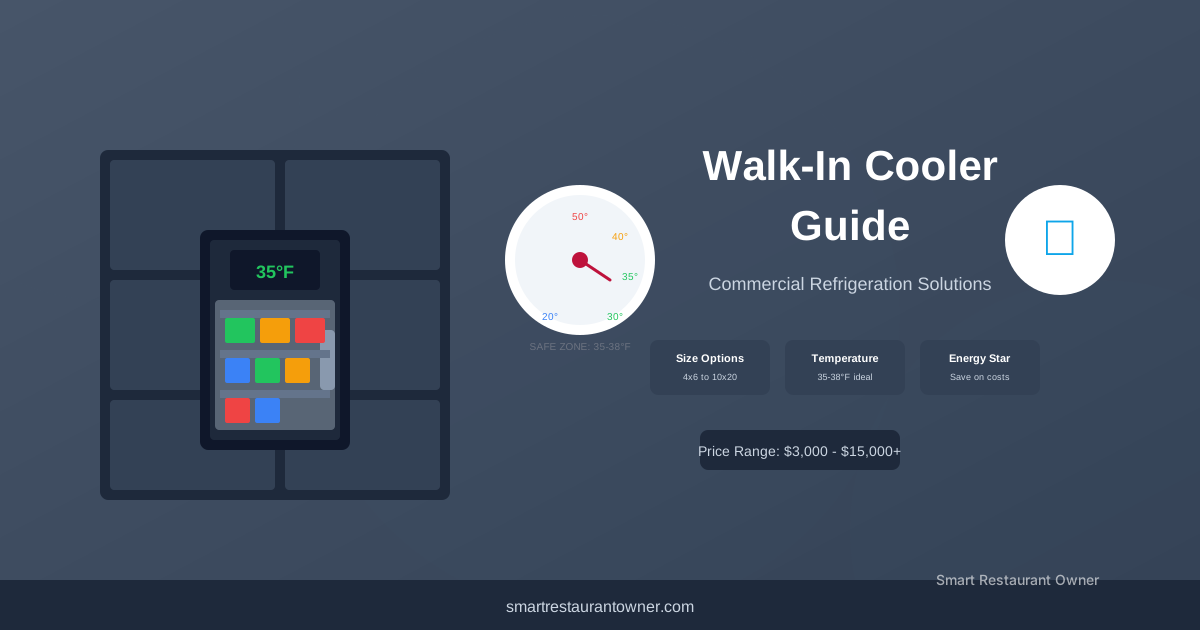
35-38 degrees Fahrenheit. Below 35 and you risk freezing product. Above 40 and you're in the danger zone. The health department requires 41 degrees or below. Set your thermostat to 36-37 degrees to allow for temperature variation.
Do I need a walk-in cooler or can I use reach-in refrigerators?
If you have more than 50 seats or do more than $800,000 in annual revenue, you need a walk-in. The storage capacity and workflow efficiency justify the cost. Below that threshold, reach-in refrigerators are more cost-effective.
Next step: A walk-in cooler is one piece of a much larger equipment puzzle. Check our essential restaurant equipment list for the complete kitchen setup guide, from ranges and fryers to smallwares.
Disclosure: Some links in this article are affiliate links. We may earn a commission if you make a purchase, at no additional cost to you. We only recommend products we've researched and believe will help restaurant owners.
Recommended Tool
Equip your restaurant with WebstaurantStore.
The #1 supplier for restaurant equipment and supplies.