
A ghost kitchen operator in Miami was running 4 virtual brands out of one kitchen: a burger concept, a wing concept, a salad concept, and a late-night cookie concept. Each brand had its own tablet. Uber Eats for burgers. DoorDash for wings. Grubhub for salads. Slice for cookies. That's 4 tablets on the counter, each pinging with orders at different volumes, each with its own interface, each needing to be accepted within 60 seconds or the order gets canceled.
On a Friday night, all 4 tablets went off within 90 seconds. 7 orders across 4 brands. The cook grabbed the wrong tablet for the wrong order. A burger customer got wings. A wing customer got a salad. Both orders were refunded. The ghost kitchen lost $67 in revenue and took two 1-star ratings. The operator bought Otter the next day.
Ghost kitchens live and die by order accuracy. When you're running 3-6 virtual brands from one kitchen, the operational complexity multiplies with every brand you add. A cloud POS that aggregates all your delivery platform orders into one screen isn't a luxury. It's the difference between a 4.2-star rating and a 3.8.
The Tablet Problem
Every delivery platform requires its own tablet. Uber Eats sends you a tablet. DoorDash sends you a tablet. Grubhub sends you a tablet. If you're on 4 platforms with 3 virtual brands, that's potentially 12 tablets. Most ghost kitchens run 3-4 tablets and toggle between brands on each one. It's manageable with 2 brands. It's chaos with 4.
The tablets have different interfaces. Uber Eats uses a swipe-to-accept gesture. DoorDash uses a tap. Grubhub uses a two-tap confirmation. When you're accepting 40 orders an hour across 4 tablets, the cognitive load of switching between interfaces causes errors. You accept the wrong order. You miss the 60-second window. You confirm an order you can't fulfill because you're out of an ingredient on that brand's menu.
A cloud POS aggregator replaces all the tablets with one screen. Orders from every platform and every brand appear in a single queue. You accept them with one tap. They print to one kitchen printer. The system routes each order to the correct brand's packaging station. The tablet chaos disappears.
The Three Aggregators That Matter
Recommended Tool
Find the right POS for your restaurant. Compare costs and features.
Use our ROI calculator to match your needs with the best system.
| Otter | Cuboh | ItsaCheckmate | |
|---|---|---|---|
| Monthly Cost (1 brand) | $99 | $79 | $89 |
| Monthly Cost (4 brands) | $199 | $159 | $179 |
| Platforms Supported | Uber Eats, DoorDash, Grubhub, Postmates, Caviar, Slice, ezCater | Uber Eats, DoorDash, Grubhub, Postmates | Uber Eats, DoorDash, Grubhub, Postmates, Caviar, Slice |
| POS Integration | Toast, Square, Clover, Lightspeed | Toast, Square, Clover | Toast, Square, Clover, Lightspeed |
| Menu Sync | Two-way | One-way | Two-way |
| Order Routing | Auto by brand | Auto by brand | Auto by brand |
| Analytics | Yes | Yes | Limited |
| Downtime (last 90 days) | 2 incidents, 18 min total | 1 incident, 7 min total | 4 incidents, 42 min total |
| Best For | Multi-brand kitchens | Budget-conscious operators | Enterprise chains |
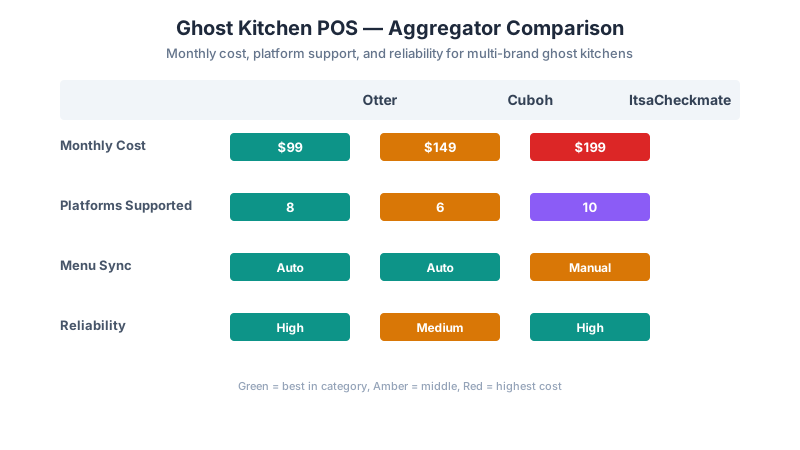
Otter is the largest ghost kitchen POS aggregator, processing orders for over 200,000 restaurant locations across 7 delivery platforms. Cuboh focuses on independent ghost kitchens and virtual brands with a streamlined feature set at a lower price point. ItsaCheckmate serves enterprise chains with centralized menu management across hundreds of locations. All three integrate with Toast, Square, and Clover POS systems. According to DoorDash's 2025 Restaurant Online Ordering Trends report, ghost kitchens running 3+ virtual brands see a 22% reduction in order errors after adopting a POS aggregator.
Otter: The Industry Standard
Otter is what most ghost kitchens use. It supports 7 delivery platforms, integrates with 4 POS systems, and handles multi-brand routing better than the alternatives. The interface is clean. The order queue shows brand, platform, customer name, order total, and time remaining to accept. Color-coded by brand. A burger order is red. A wing order is orange. A salad order is green. You can't confuse them.
Otter's menu sync is two-way. When you update a price or 86 an item in Otter, it pushes to all connected platforms simultaneously. When a platform changes its menu formatting requirements, Otter pulls the change and adjusts. Cuboh's sync is one-way: you push from Cuboh to the platforms, but platform-side changes don't sync back. If DoorDash changes your menu categorization without telling you, Cuboh won't catch it. Otter will.
The downside: Otter costs $199/month for 4 brands. Cuboh costs $159. ItsaCheckmate costs $179. The $40/month difference between Otter and Cuboh is $480 a year. For a ghost kitchen doing $400,000 a year, that's 0.12% of revenue. The two-way menu sync alone is worth it.
Otter had 2 downtime incidents in the last 90 days totaling 18 minutes. During those 18 minutes, orders still came through on the individual platform tablets. Otter's failover routes orders to the native tablet apps when their system is down. You're not dead in the water. You're just back to managing 4 tablets for 18 minutes.
Cuboh: The Budget Alternative
Cuboh does 80% of what Otter does for 20% less money. The order aggregation works. The multi-brand routing works. The analytics dashboard shows revenue by brand, platform, and time period. For a ghost kitchen with 2-3 brands doing straightforward delivery-only operations, Cuboh is adequate.
Where Cuboh falls short: the menu sync is one-way only. If a platform changes your menu, you won't know until customers start ordering items you don't have or can't find items you do have. The platform support is narrower: 4 platforms versus Otter's 7. If you're on Slice or ezCater, Cuboh doesn't support them.
Cuboh's reliability is actually better than Otter's: 1 downtime incident in 90 days, 7 minutes total. But the failover isn't as smooth. When Cuboh goes down, orders don't automatically route to the native tablets. You have to manually log into each platform's tablet and start accepting orders there. In a busy kitchen, those 7 minutes of confusion cost you 2-3 missed orders.
ItsaCheckmate: The Enterprise Option
ItsaCheckmate is built for chains with 10+ locations. The centralized menu management lets you update all locations from one dashboard. The analytics compare performance across locations. The integration depth with enterprise POS systems like Brink and Oracle Simphony is better than Otter or Cuboh.
For a single ghost kitchen with 3-6 brands, ItsaCheckmate is overkill. The interface is more complex. The setup takes 2-3 weeks versus 3-5 days for Otter. The analytics are powerful but you need a dedicated operations person to use them. At $179/month for 4 brands, it's priced between Otter and Cuboh but delivers less value for a small operation.
ItsaCheckmate's reliability is the worst of the three: 4 downtime incidents in 90 days, 42 minutes total. For a chain with an IT department, 42 minutes of downtime is manageable. For a ghost kitchen where the cook is also the order manager, 42 minutes of confusion is a bad Friday night.
The Integration Tax
All three aggregators charge a setup fee: $199-$499 depending on the number of brands and platforms. The setup involves connecting each platform account, mapping each menu item, and configuring the routing rules. It takes 3-5 days for Otter, 5-7 days for Cuboh, and 2-3 weeks for ItsaCheckmate.
After setup, you pay a monthly fee per brand. The more brands you run, the higher the fee. But the more brands you run, the more value the aggregator provides. A ghost kitchen with 2 brands can manage 2 tablets. A ghost kitchen with 5 brands needs an aggregator. The math flips at 3 brands.
Also factor in the POS integration. If you use Toast or Square, the aggregator pushes orders directly to your POS and your kitchen display system. No manual entry. If you don't use a POS, the aggregator prints orders to a kitchen printer. The printer setup is included in the setup fee.
My Recommendation
For ghost kitchens with 3+ virtual brands, buy Otter. The two-way menu sync prevents the "customer ordered an item we 86'd last week" problem. The 7-platform support covers every delivery service you might use. The $199/month cost is 0.05-0.1% of revenue for a ghost kitchen doing $200,000-$400,000 a year. The order accuracy improvement alone is worth it.
For ghost kitchens with 2 brands, try Cuboh first. At $99/month for 1-2 brands, it's the cheapest entry point. If the one-way menu sync causes problems, upgrade to Otter. The $40/month difference is worth testing before committing.
Don't buy ItsaCheckmate unless you have 10+ locations. The enterprise features are powerful but irrelevant for a single ghost kitchen. The setup time is too long. The reliability is too inconsistent.
For more on POS selection, see our Toast vs Square vs Clover comparison and our restaurant POS buying guide. Run your delivery economics through our restaurant break-even calculator. If you're launching a ghost kitchen, our ghost kitchen business guide covers startup costs and platform strategy. For online ordering fees, see our online ordering system fees comparison.
A Warning About Aggregator Failover
A ghost kitchen in Los Angeles ran 4 brands with Otter aggregating orders from DoorDash, Uber Eats, and Grubhub. Otter went down during a Friday dinner rush. The failover was supposed to route orders back to the individual tablets, but it didn't trigger correctly. Orders from DoorDash went to the Otter screen and stopped appearing. Orders from Uber Eats were accepted on Otter but never printed in the kitchen. The cook spent 45 minutes manually checking each platform on a phone to see what orders had come in. Six orders were never fulfilled. The kitchen comped $142 in refunds. Three customers left 1-star reviews mentioning "order never received." It took 3 weeks to rebuild the rating from 4.3 to 4.6.
Aggregators are reliable but not perfect. Keep backup iPads loaded with each platform's tablet app, charged and ready. The backup setup costs about $300 per platform. The cost of an unprotected outage during a Friday dinner rush is much higher.
FAQ
What is a cloud POS for ghost kitchens?
A cloud POS aggregator combines orders from multiple delivery platforms (Uber Eats, DoorDash, Grubhub) and multiple virtual brands into a single screen. It replaces the individual tablets each platform requires with one unified order queue.
How much does a ghost kitchen POS aggregator cost?
Otter costs $99-$199/month depending on the number of brands. Cuboh costs $79-$159/month. ItsaCheckmate costs $89-$179/month. Setup fees range from $199-$499. Most ghost kitchens with 3+ brands pay $159-$199/month.
Can I run multiple virtual brands without a POS aggregator?
Yes, but it's operationally painful. Each brand needs its own tablet for each delivery platform. With 3 brands on 3 platforms, that's 9 tablets. Order errors increase. Acceptance times slow down. Most ghost kitchens with 3+ brands use an aggregator.
Which delivery platforms does Otter support?
Otter supports Uber Eats, DoorDash, Grubhub, Postmates, Caviar, Slice, and ezCater. Cuboh supports the first 4. ItsaCheckmate supports the first 4 plus Caviar and Slice.
How long does it take to set up a ghost kitchen POS aggregator?
Otter: 3-5 days. Cuboh: 5-7 days. ItsaCheckmate: 2-3 weeks. The setup involves connecting each delivery platform account, mapping menu items, and configuring brand routing rules.
Recommended Tool
Not sure which POS to choose?
Our comparison tools help you pick the right system for your concept and budget.