
A restaurant group in Austin tested dynamic pricing on their weekend dinner menu in January 2025. They raised prices 12% on Friday and Saturday nights between 6pm and 8pm. They lowered prices 8% on Tuesday and Wednesday nights. They didn't change the menu. They didn't announce the change. They just changed the prices in their POS.
After 4 months, weekend revenue was up 9.4%. Tuesday/Wednesday covers were up 14%. Total revenue was up 7.2%. Customer complaints: zero. Not a single guest noticed the price difference. The weekend guests were happy to get a table. The weekday guests were happy to get a deal. The restaurant made $47,000 more in 4 months with no additional costs.
Dynamic pricing isn't surge pricing. It's not Uber charging 2.5x during a rainstorm. It's charging what your tables are worth at different times, which is what hotels and airlines have done for 40 years. Restaurants are the last hospitality sector to adopt it. Here's how to do it without alienating your customers.
The Three Types of Restaurant Dynamic Pricing
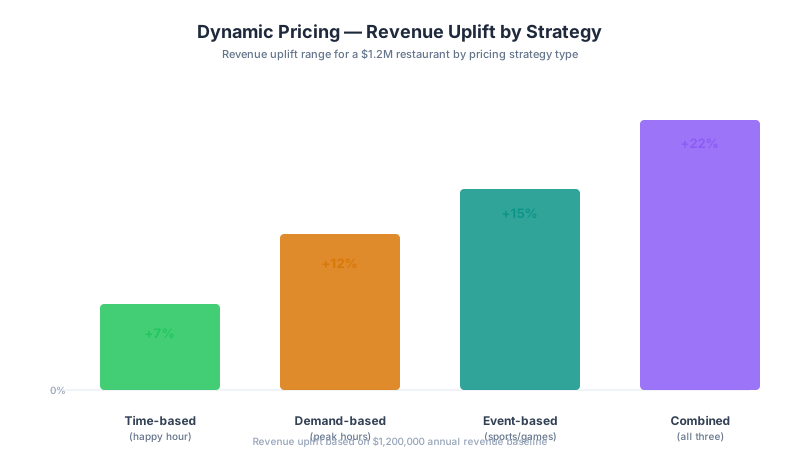
Time-based pricing. Different prices for different days or dayparts. Weekend dinner costs more than Tuesday lunch. Happy hour costs less than prime time. This is the easiest to implement and the least likely to generate complaints. Customers already expect weekend dinners to cost more than weekday lunches, even if the menu prices are the same. They just don't think about it.
Demand-based pricing. Prices change based on how many reservations you have. A 7pm Saturday table costs more than a 9pm Saturday table because demand is higher at 7pm. This requires a reservation system that supports variable pricing (Resy, Tock, OpenTable all do). It's more complex than time-based pricing but captures more revenue.
Event-based pricing. Higher prices during local events. Restaurant Week? Lower prices to compete. SXSW in town? Raise prices 15-20%. The demand spike from events is temporary. Customers expect to pay more during big events. The window is short. Capture the revenue while it's there.
| Time-Based | Demand-Based | Event-Based | |
|---|---|---|---|
| Implementation Difficulty | Easy | Medium | Easy |
| Customer Backlash Risk | Very Low | Low | Very Low |
| Revenue Uplift | 5-10% | 8-15% | 10-20% |
| Technology Required | POS only | POS + Reservation System | POS only |
| Best For | All restaurants | High-demand restaurants | Event-adjacent restaurants |
According to the National Restaurant Association's 2026 State of the Industry report, 32% of full-service operators are exploring variable pricing strategies, up from 18% in 2023. Resy and Tock both support variable pricing for reservations, allowing restaurants to charge different prices for different time slots. OpenTable added dynamic pricing features in 2025. The Cornell Center for Hospitality Research has published multiple studies showing that restaurant demand elasticity averages -0.8 to -1.2, meaning a 10% price increase typically results in only an 8-12% drop in covers, producing net revenue gains at peak times.
The Psychology of Restaurant Pricing
Recommended Tool
Track your inventory in real-time and reduce food waste with MarketMan.
Used by 2,400+ restaurants to optimize their purchasing.
Customers don't remember absolute prices. They remember value. A $34 steak on a Saturday night feels fair if the experience is good. A $28 steak on a Tuesday feels like a deal. The same steak. Different prices. Different perception. Both positive.
The key is that customers compare your prices to their expectations, not to your other prices. A Saturday guest doesn't know your Tuesday prices. A Tuesday guest doesn't know your Saturday prices. They only know what they paid and whether it felt worth it.
This is why dynamic pricing works in restaurants but not in retail. In retail, customers can compare prices across time (I bought this shirt for $40 last week and now it's $30). In restaurants, the experience is consumed immediately. There's no price comparison across visits because the context is different every time.
The one exception: regulars who visit on different days. A regular who comes Tuesday and Saturday will notice the price difference. The solution: a loyalty program that gives regulars a consistent price regardless of when they visit. The loyalty discount costs less than the revenue you gain from dynamic pricing on peak days.
How to Implement Time-Based Pricing
Step 1: Identify your peak and off-peak periods. Look at 12 months of sales data. Find the days and dayparts with the highest demand (Friday/Saturday dinner, Sunday brunch) and the lowest (Tuesday/Wednesday dinner, Monday lunch).
Step 2: Calculate your price elasticity. Raise prices 5% on a peak period for 2 weeks. Measure the change in covers. If covers drop less than 2%, raise another 5%. If covers drop more than 5%, pull back to 3%. Find the point where the revenue gain from higher prices exceeds the revenue loss from fewer covers.
Step 3: Lower prices on off-peak periods. A 10% price reduction on Tuesday dinner that increases covers by 20% generates 8% more revenue. The math: 100 covers × $40 = $4,000. 120 covers × $36 = $4,320. The lower price generates more revenue because the volume increase exceeds the price decrease.
Step 4: Don't change the menu. Change the prices in your POS. Print separate menus for peak and off-peak if you use physical menus. If you use QR code menus, the digital menu can show different prices based on the day and time automatically.
The Happy Hour Optimization
Happy hour is dynamic pricing in reverse. You lower prices during slow periods to drive volume. Most restaurants do happy hour wrong. They discount everything 20-30% from 4pm-6pm. The result: they fill the bar with low-margin customers who would have come anyway.
Smart happy hour: discount high-margin items only. A $12 cocktail that costs $1.80 to make has an 85% margin. Discount it to $8 and the margin is still 77.5%. You make $6.20 instead of $10.20, but you sell 3x as many. A $14 appetizer that costs $4.20 to make has a 70% margin. Discount it to $10 and the margin is 58%. You make $5.80 instead of $9.80, but you sell 2x as many.
Don't discount low-margin items during happy hour. A $26 entree that costs $11 to make has a 58% margin. Discount it to $18 and the margin drops to 39%. You make $7 instead of $15. You need to sell more than 2x as many to break even on revenue. You won't.
The happy hour menu should be 5-7 high-margin items: 2-3 cocktails, 2-3 appetizers, 1-2 desserts. No entrees. No wine (wine margins are lower than cocktail margins). No items that require significant kitchen labor. The goal is to fill seats during slow periods with high-margin sales, not to discount your entire menu.
The Weekend Pricing Strategy
Weekend dinner is your highest-demand period. You have more customers than tables. Raising prices 8-15% on Friday and Saturday nights captures revenue you're currently leaving on the table.
The math: a restaurant with 80 seats doing 2 turns on Saturday night serves 160 covers. Average check: $55. Revenue: $8,800. Raise prices 12%: average check $61.60. If covers stay the same: $9,856. If covers drop 5% (152 covers): $9,363. Both are higher than $8,800. The price increase generates more revenue even with fewer covers.
The risk: customers perceive the restaurant as expensive and stop coming. This risk is overblown. Customers choose restaurants based on location, cuisine, reviews, and recommendations. Price is 5th or 6th on the list. A 12% price increase on a $55 average check is $6.60. Most customers don't notice $6.60 on a $110 dinner for two.
The real risk is your online menu showing higher prices. New customers see the weekend prices and think you're expensive. The solution: show a price range on your website menu ($26-$34 for the steak) or show the weekday price with a note that weekend pricing may vary. Most restaurants don't put prices on their website menu at all, which solves this problem by creating a different one (Google can't read your menu for AI Overviews).
My Recommendation
Start with time-based pricing. It's the easiest to implement and the least risky. Raise weekend dinner prices 8-12%. Lower Tuesday/Wednesday prices 5-10%. Run it for 3 months. Measure the revenue impact. Adjust.
Add happy hour optimization. Replace your across-the-board happy hour discount with a curated menu of 5-7 high-margin items at 25-35% off. Track the margin on happy hour sales before and after the change. The revenue might stay the same. The profit will increase.
Consider demand-based pricing if you're on Resy or Tock and consistently booked 2+ weeks out. The reservation platforms handle the variable pricing automatically. You set the price tiers. The platform charges the customer. The implementation is straightforward. The revenue uplift is 8-15%.
Don't do event-based pricing unless you're in a city with major events (Austin during SXSW, New Orleans during Mardi Gras, Indianapolis during Gen Con). The event premium is 15-25% and customers expect it. The window is 3-10 days. Capture it.
For more on restaurant finance, see our restaurant break-even calculator and our menu price optimizer. Our menu engineering guide covers the profitability analysis that underpins any pricing strategy. For pricing psychology, see The Psychology of Menu Pricing.
A Warning About Ignoring Your Regulars
A restaurant in Denver implemented dynamic pricing. Weekend dinner prices went up 15%. Weekday lunch prices went down 10%. Revenue increased 8% in the first 2 months. Then the general manager noticed a problem: Tuesday lunch regulars had stopped coming. A group of 8 business professionals who had visited every Tuesday for 3 years had shown up once in the previous 6 weeks. The manager called one of them. The response: "We noticed the prices were different on different days and it felt like you were taking advantage of us on weekends." The regulars weren't upset about the weekday discount. They were upset that the weekend markup felt manipulative.
The restaurant rolled back weekend prices and offered the regulars a small loyalty discount. The regulars returned. The dynamic pricing program went from an 8% lift to 3%, but the customer base stabilized. Dynamic pricing works best when your regulars don't see both sides of the equation. If you have a core group of multi-day regulars, offer them a consistent price through a loyalty program.
FAQ
What is dynamic pricing in restaurants?
Dynamic pricing means charging different prices for the same menu items based on time, demand, or events. Weekend dinner costs more than Tuesday lunch. A 7pm reservation costs more than a 9pm reservation. It's the same concept hotels and airlines have used for decades.
Will customers notice dynamic pricing?
Rarely. Customers compare prices to their expectations, not to your other prices. A Saturday guest doesn't know your Tuesday prices. The exception is regulars who visit on different days. Offer them a loyalty price to maintain consistency.
How much more revenue can dynamic pricing generate?
Time-based pricing generates 5-10% more revenue. Demand-based pricing generates 8-15%. Event-based pricing generates 10-20% during event periods. A restaurant doing $1.2 million a year can add $60,000-$180,000 in revenue with no additional costs.
How do I implement dynamic pricing without a reservation system?
Use time-based pricing with your POS. Print separate menus for peak and off-peak periods, or use QR code menus that display different prices based on day and time. No reservation system required.
Is dynamic pricing legal for restaurants?
Yes. Dynamic pricing is legal in all 50 states as long as prices are disclosed before the customer orders. The menu must show the actual price the customer will pay. You can't advertise one price and charge another.
Recommended Tool
Streamline your inventory management with MarketMan.
Get real-time tracking, automated ordering, and waste reduction.