
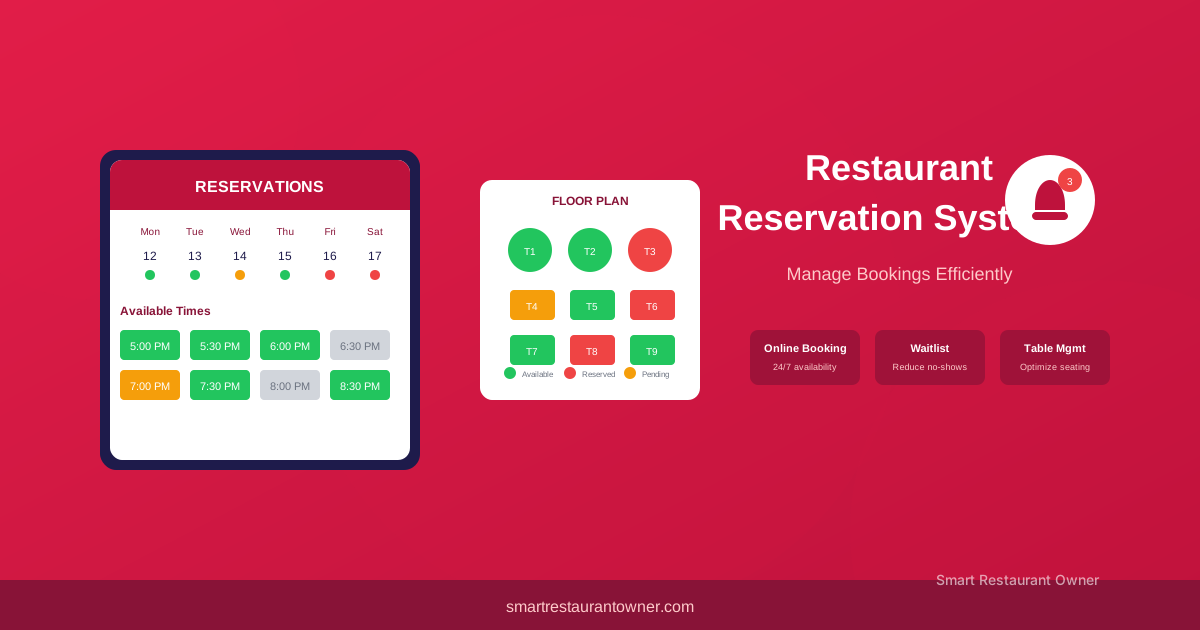
A fine dining restaurant in Chicago did 380 covers on a Saturday night in October. Their reservation system double-booked a 6-top at 7:30 PM. Two parties of 6 showed up. One had been waiting 3 weeks for this reservation. The other was a regular who spent $400+ per visit. The manager comped $600 in food and drinks, lost one of the regulars permanently, and got a 1-star review that's still the first thing people see on Google. The reservation system that caused this costs them $249 a month.
Reservation systems aren't just digital reservation books anymore. They're guest data platforms, marketing engines, and revenue management tools. According to the National Restaurant Association's 2026 State of the Industry report, technology adoption in restaurants has accelerated, with reservation and guest management tools ranking among the top operational investments. The right one increases your revenue per cover. The wrong one costs you regulars you spent years building.
I've watched restaurants switch between these three platforms enough times to know exactly where each one wins and where each one fails. Here's the breakdown.
Quick Comparison
| Feature | OpenTable | Resy | SevenRooms |
|---|---|---|---|
| Monthly Cost | From $249/month | From $199/month | From $400/month |
| Per-Cover Fee | $1.00 per seated cover | $0.25-$0.75 per booked cover | None (flat fee) |
| Best For | Independent restaurants needing discovery | Chef-driven / fine dining with existing demand | Multi-location groups wanting guest data ownership |
| Waitlist Feature | Basic waitlist with notifications | Smart waitlist with auto-confirm window | Custom waitlist with SMS + email reminders |
| CRM Capability | Limited (data stays on OpenTable) | Strong guest profiles, Amex integration | Full CRM with marketing automation |
| Table Management | Drag-and-drop floor plan, turn tracking | Table assignment, status tracking | Table management with capacity planning |
| Diner Network | 60,000+ restaurants, ~30M diners | ~16,000 restaurants, fewer diners | None (you bring your own guests) |
| No-Show Prevention | Diner reliability scores | Credit card hold + no-show fee | Custom policies + automated reminder sequence |
| Guest Data Ownership | No (OpenTable owns it) | Partial (can export basic data) | Yes (full data export) |
The Short Answer
Recommended Tool
Track your inventory in real-time and reduce food waste with MarketMan.
Used by 2,400+ restaurants to optimize their purchasing.
If you're a single independent restaurant doing under $2M in revenue, use OpenTable. Yes, the cover fees are high ($1.00 per seated cover + $249/month). Yes, you're paying for their diner network. But the diner network is the point. OpenTable brings you customers you wouldn't otherwise reach. For a restaurant that needs discovery, that's worth more than the fees.
If you're a chef-driven or fine dining restaurant that already has demand, use Resy. The cover fee is lower ($0.25-$0.75 per cover), the interface is cleaner, and the guest profiles are more detailed. Resy doesn't have OpenTable's diner network size, but if you're already booked out 2 weeks, you don't need discovery. You need better guest management.
If you're a multi-location group or a high-volume restaurant that wants to own guest data and run your own marketing, use SevenRooms. It's the most expensive ($400-$1,000/month) but it pays for itself if you use the marketing automation. A 5-location group in Denver switched from OpenTable to SevenRooms and saved $42,000 a year in cover fees. They reinvested $12,000 of that in email marketing and increased repeat visits by 18%.
The Cover Fee Trap
OpenTable charges per seated cover. Resy charges per booked cover. SevenRooms charges a flat monthly fee with no per-cover charges. The difference matters.
A restaurant doing 3,000 covers per month pays:
- OpenTable: $249 base + $3,000 in cover fees = $3,249/month
- Resy: $199 base + $1,500 in cover fees (at $0.50/cover) = $1,699/month
- SevenRooms: $500 flat (no cover fees) = $500/month
Over a year, the difference between OpenTable and SevenRooms is $32,988. For a restaurant with 8% net margins, that's the profit from $412,350 in revenue.
But here's the thing: OpenTable's diner network generates covers you wouldn't otherwise get. If OpenTable brings in 400 covers a month that wouldn't have found you otherwise, and your average check is $65, that's $26,000 in incremental revenue. The $3,249 monthly fee is a 12.5% marketing cost on those incremental covers. That's actually reasonable.
The question isn't "which is cheapest." It's "how many of my covers come from the platform's diner network vs my own reputation." If you're in a high-traffic area and people find you through Google Maps and word of mouth, you're overpaying for OpenTable's network. If you're a neighborhood spot that needs discovery, OpenTable's network is your marketing budget.
I've seen restaurants switch from OpenTable to Resy. Their covers dropped 15% in the first month. They panicked and almost switched back. Then they looked at the data. The 15% drop was entirely from first-time diners. Their regular covers were unchanged. Revenue per cover went up because the OpenTable diners had been lower-spend. They kept Resy and redirected the $2,000/month savings into Instagram ads targeting their neighborhood. Covers recovered in 3 months with better-quality diners. If you're thinking about how to allocate marketing budget for your restaurant, our restaurant marketing plan guide walks through channel-by-channel budgeting.
OpenTable: The Diner Network
OpenTable has 60,000+ restaurants and roughly 30 million diners in their network, according to OpenTable's corporate site. When someone searches "Italian restaurant near me" on OpenTable, your restaurant shows up. That's the value proposition. You're paying for distribution.
Pricing: Basic is $249/month + $1.00 per seated cover. Core is $349/month + $1.00 per seated cover (adds floor management and shift planning). Pro is $449/month + $1.00 per seated cover (adds guest analytics and marketing automation).
What it does well: The diner network is the product. Everything else is secondary. OpenTable's floor management is solid. The table assignment view is intuitive. You can drag reservations between tables, track table status, and estimate turn times. The guest profiles show dining history, allergies, and special occasions. The mobile app for diners is polished and widely used. How your hosts use that guest data at the door matters more than the platform itself. Our customer service training guide covers how to turn reservation notes into better guest experiences.
Where it falls short: You don't own the guest data. When a diner books through OpenTable, OpenTable owns the relationship. You can't export guest emails and import them into your own marketing system. You can send marketing emails through OpenTable's platform, but if you leave OpenTable, you lose access to those guest profiles. The cover fees add up fast. A busy restaurant doing 5,000 covers a month pays $5,000 in cover fees alone. That's $60,000 a year. For that money, you could hire a part-time marketing person.
Who should use it: Independent restaurants that need discovery. New restaurants building a customer base. Restaurants in competitive neighborhoods where being bookable on OpenTable is table stakes. If 30%+ of your covers come from first-time diners, OpenTable's network is worth the cost.
Resy: The Chef's Choice
Resy was founded by Eater co-founder Ben Leventhal and acquired by American Express in 2019, as reported by Eater. It's positioned as the premium alternative to OpenTable. The interface is cleaner. The guest profiles are richer. The Amex integration gives you access to Amex cardholders, who tend to spend more per cover.
Pricing: Resy doesn't publish pricing publicly. Based on conversations with restaurant operators, expect $199-$399/month base + $0.25-$0.75 per booked cover. Amex cardholders get priority access to certain reservations through the Global Dining Access program.
What it does well: The guest profiles are the best in the industry. Resy tracks dining history, preferences, allergies, special occasions, and spending patterns. You can tag guests as VIPs, note their favorite table, and set alerts for when they book. The waitlist management is smarter than OpenTable's. Resy automatically notifies waitlisted guests when a table opens and gives them a time window to confirm. The no-show protection is aggressive. Resy requires a credit card for prime-time reservations and charges a fee for no-shows.
Where it falls short: The diner network is smaller than OpenTable's. Resy has about 16,000 restaurants and fewer active diners. If discovery is your primary need, Resy won't bring as many new covers. The Amex integration is a double-edged sword. Amex cardholders get preferential access, which is great for check averages but can frustrate non-Amex regulars. Customer support is slower than OpenTable's. Several operators told me they waited 24-48 hours for responses to urgent issues.
Who should use it: Chef-driven restaurants with existing demand. Fine dining restaurants where guest recognition matters. Restaurants in markets where Resy has strong adoption (New York, Los Angeles, Chicago, San Francisco). If you're already turning away covers on weekends, you don't need OpenTable's network. You need Resy's guest management.
📬 Get More Customers. Get More Profit.
Join 2,400+ restaurant owners getting actionable tips every Friday. One email. One insight. No spam.
SevenRooms: The Marketing Platform
SevenRooms isn't really a reservation system. It's a guest data and marketing platform that happens to include reservations. The distinction matters because it changes how you think about the cost. According to SevenRooms, their platform focuses on guest retention and direct revenue recovery rather than discovery.
Pricing: SevenRooms doesn't publish pricing. Based on operator conversations, expect $400-$1,000/month depending on features and location count. No per-cover fees. The platform includes reservations, waitlist, table management, guest profiles, email marketing, and automated marketing campaigns.
What it does well: You own your guest data. Every email, every preference, every visit history is yours. If you leave SevenRooms, you take your data with you. The marketing automation is the real product. SevenRooms can automatically send a "we miss you" email to guests who haven't visited in 60 days, a birthday offer 2 weeks before their birthday, and a post-visit feedback request 24 hours after dining. The ROI on these automated campaigns is measurable. The Denver group I mentioned tracks a 14:1 return on their SevenRooms marketing spend. If you're thinking about building a loyalty program alongside your reservation system, our restaurant loyalty program guide breaks down the options.
Where it falls short: No diner network. SevenRooms doesn't bring you new customers. It helps you get more value from existing customers. The setup is involved. You need to configure guest tags, marketing automations, and reporting dashboards. Plan on 2-4 weeks of setup and training. The interface is powerful but not intuitive. Your host will need training. The mobile app for hosts is functional but not as polished as OpenTable's or Resy's.
Who should use it: Multi-location restaurant groups. High-volume restaurants that want to build a direct relationship with guests. Restaurants with an existing customer base that want to increase visit frequency and spend per visit. If you're spending $2,000+/month on OpenTable cover fees, SevenRooms pays for itself.
The Guest Data Question
This is the single most important strategic decision in choosing a reservation system. Who owns the relationship with your guests?
OpenTable owns it. When a diner books through OpenTable, OpenTable has the email, the dining history, and the preferences. You can see it while you're on OpenTable. You can't take it with you. If you've been on OpenTable for 5 years and decide to switch, you lose 5 years of guest data.
Resy is in between. You can export guest data, but the richest profiles (Amex integration data, cross-restaurant dining history) stay with Resy.
SevenRooms gives you everything. Guest profiles, visit history, preferences, tags, notes. It's your data. You can export it, analyze it, and use it in other systems.
A restaurant group in Miami learned this the hard way. They'd been on OpenTable for 8 years. They had 45,000 guest profiles with dining history. When they switched to SevenRooms, they lost access to all of it. They had to rebuild their guest database from scratch. It took 18 months to get back to the same level of guest intelligence. If you think you might ever switch platforms, start exporting your guest data now. OpenTable won't make it easy, but it's possible through their reporting tools.
Which One Actually Reduces No-Shows?
No-shows cost the average full-service restaurant $2,400-$3,800 per month in lost revenue, based on data from 7shifts' 2024 Restaurant Operations Report. A reservation system that reduces no-shows by 50% pays for itself. That said, your Google Business Profile is where most people find you before booking. Making sure your profile is set up correctly with updated hours, photos, and a direct booking link can reduce friction before diners even reach your reservation platform. Our Google My Business guide for restaurants covers the setup.
Resy has the most aggressive no-show prevention. Credit card requirements for prime-time slots. Automatic waitlist notifications. A no-show fee that actually gets charged. Restaurants I've talked to report 60-70% reduction in no-shows after switching to Resy.
OpenTable's no-show prevention is softer. They track diner reliability scores and penalize repeat no-shows by restricting their booking privileges. It works over time but doesn't stop the first no-show.
SevenRooms lets you set custom no-show policies. Credit card holds, prepayment requirements, and automated reminder emails and texts. The reminder sequence (48 hours, 24 hours, 4 hours before reservation) is the most effective no-show prevention tool, and SevenRooms automates it best.
FAQ
Can I use OpenTable and Resy at the same time?
Technically yes, but you shouldn't. Managing inventory across two platforms means you'll double-book tables. Pick one.
Does SevenRooms integrate with my POS?
SevenRooms integrates with Toast, Square, Lightspeed, and most major POS systems. The integration syncs guest data and check details automatically.
What happens to my OpenTable reviews if I switch?
Your OpenTable reviews stay on OpenTable. They're tied to your restaurant listing, not your subscription. You can still claim and respond to reviews even after canceling.
Is there a free reservation system?
Tablein offers a free plan for up to 300 covers per month. It's basic but functional. Good for very small restaurants or pop-ups. You'll outgrow it quickly if you're doing real volume.
Next steps:
Your reservation system is one piece of the puzzle. To get the most out of the guest data you collect, you need a marketing plan that turns first-time diners into regulars. Read our restaurant marketing plan for a channel-by-channel approach. If you're ready to build a loyalty program that works alongside your reservation platform, our restaurant loyalty program guide covers the frameworks that actually drive repeat visits. Calculate the ROI of switching systems with our restaurant ROI calculator.
Disclosure: Some links in this article are affiliate links. We may earn a commission if you make a purchase, at no additional cost to you. We only recommend products we've researched and believe will help restaurant owners.
Recommended Tool
Streamline your inventory management with MarketMan.
Get real-time tracking, automated ordering, and waste reduction.