
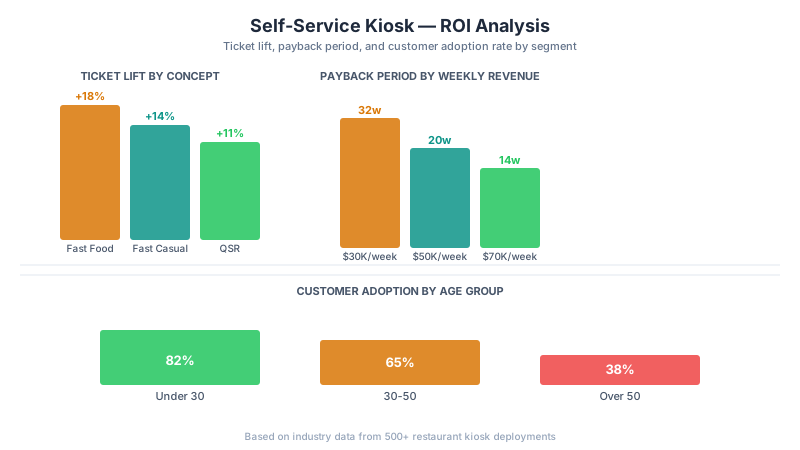
A QSR franchisee in Dallas installed 4 self-service kiosks in his busiest location in January 2025. The kiosks cost $18,400 total ($4,600 each). He kept 2 cashier lanes and converted 2 to kiosk-only. After 6 months, his average ticket was up 18% ($11.40 to $13.45). His labor cost dropped by $2,800 a month because he scheduled one fewer cashier per shift. His monthly revenue increased by $14,200 from the ticket lift and faster throughput. The kiosks paid for themselves in 4.7 months.
A different franchisee in the same chain installed 2 kiosks in a slower location doing $28,000 a week. The kiosks cost $9,200. After 6 months, his average ticket was up 11%. His labor savings were $1,100 a month. The kiosks paid for themselves in 8.4 months. Still positive. Still worth it. But the ROI was 44% slower than the high-volume location.
Self-service kiosks are not a universal win. The ROI depends on your volume, your menu complexity, and your customer demographics. Here's what the numbers actually look like.
The Ticket Lift Is Real
Every QSR operator I've talked to who installed kiosks reports a ticket lift of 11-22%. The mechanism is straightforward: a kiosk never forgets to upsell. A human cashier asks "would you like fries with that?" maybe 60% of the time during a rush. A kiosk asks 100% of the time. It also suggests items the customer might not have considered: "Customers who ordered this also added a milkshake." The kiosk doesn't get tired, doesn't get embarrassed, and doesn't skip the upsell because there's a line.
The ticket lift varies by concept:
- Burger QSR: 15-22% lift. The upsell path is natural: burger → fries → drink → dessert.
- Pizza QSR: 8-14% lift. Fewer natural add-ons. Customers know what they want.
- Sandwich/Deli: 12-18% lift. Sides and drinks drive the increase.
- Coffee/Cafe: 10-16% lift. Pastry add-ons and size upgrades.
The lift is highest in the first 3 months as customers explore the kiosk interface. It settles to a steady 11-18% after the novelty wears off. The lift is permanent. Customers who order at kiosks consistently spend more than customers who order at the counter.
The Labor Math
Recommended Tool
Track your inventory in real-time and reduce food waste with MarketMan.
Used by 2,400+ restaurants to optimize their purchasing.
A kiosk replaces a cashier during non-peak hours. During peak hours, it supplements cashiers. The labor model shifts from "one cashier per register" to "one cashier plus 2-3 kiosks."
A cashier costs $14-$18/hour including payroll taxes and benefits. At $16/hour for an 8-hour shift, that's $128 a day. Over 350 operating days, $44,800 a year. A kiosk costs $4,600 once plus $50-$80/month for software and maintenance. Annual kiosk cost: $600-$960.
If a kiosk replaces one cashier shift per day, the annual savings are $44,800 - $960 = $43,840. The kiosk pays for itself in 5-6 weeks. But that's the best case. Most restaurants don't eliminate a full cashier position. They reduce cashier hours by 20-40%. The savings are $9,000-$18,000 a year per kiosk. Payback: 3-6 months.
The real labor win isn't elimination. It's reallocation. The cashier who used to spend 6 hours taking orders now spends 3 hours taking orders and 3 hours running food, cleaning the dining room, or helping customers at the kiosks. The labor cost stays the same. The customer experience improves. The throughput increases.
The Throughput Effect
A human cashier processes 25-35 transactions per hour during peak. A kiosk processes 35-45. The difference is 10 transactions per hour per kiosk. At an average ticket of $12, that's $120 more revenue per hour per kiosk. During a 3-hour lunch rush, $360. Over 350 days, $126,000 in additional throughput capacity.
But throughput only matters if you have the kitchen capacity to handle it. If your kitchen is already at capacity during peak, faster ordering just creates a longer wait for food. The kiosk doesn't speed up your grill. It speeds up your ordering. Make sure your kitchen can handle the additional volume before you invest in faster ordering.
One operator I talked to installed kiosks and saw order volume increase 22% during lunch. His kitchen couldn't keep up. Wait times went from 6 minutes to 11 minutes. Customer satisfaction dropped. He had to add a grill cook at $18/hour to handle the volume. The kiosk ROI calculation didn't include the additional kitchen labor. It should have.
The Customer Demographic Split
Kiosk adoption varies dramatically by customer age:
- Under 35: 70-85% choose kiosk over cashier when both are available.
- 35-50: 45-60% choose kiosk.
- 50-65: 20-35% choose kiosk.
- 65+: 5-15% choose kiosk.
If your customer base skews older, kiosks will have lower adoption and lower ROI. If you're near a college campus or in a neighborhood with young professionals, kiosks will have high adoption. One operator near a university reported 82% kiosk adoption within 3 months. Another in a retirement community reported 12%.
You need at least one cashier lane regardless of kiosk count. Some customers will never use a kiosk. Some transactions are too complex for a kiosk (large catering orders, special requests, gift card purchases). The cashier handles these. The kiosks handle the standard transactions.
The Hardware Options
| Toast Kiosk | Square Kiosk | Clover Kiosk | GRUBBRR | |
|---|---|---|---|---|
| Hardware Cost | $4,200-$5,500 | $3,500-$4,500 | $4,500-$6,000 | $3,000-$4,500 |
| Monthly Software | Included with POS | Included with POS | $29-$49 | $49-$79 |
| POS Integration | Native (Toast) | Native (Square) | Native (Clover) | 40+ POS systems |
| Screen Size | 22-inch | 21.5-inch | 21.5-inch | 22-inch |
| Payment Terminal | Built-in | Built-in | Built-in | Built-in |
| Accessibility | ADA compliant | ADA compliant | ADA compliant | ADA compliant |
| Best For | Toast restaurants | Square restaurants | Clover restaurants | Multi-POS operations |
Toast Kiosk integrates natively with Toast POS. The menu syncs automatically. The kiosk transactions flow into the same kitchen display system as counter orders. No middleware. No integration headaches. If you're on Toast, buy Toast Kiosk.
Square Kiosk integrates natively with Square. Same benefits. If you're on Square, buy Square Kiosk. The Square Kiosk is slightly cheaper than Toast's and the interface is cleaner. Square's consumer-grade design DNA shows here in a good way.
GRUBBRR is the independent option. It works with 40+ POS systems including legacy systems that Toast and Square don't support. If you're on a POS that doesn't have a native kiosk, GRUBBRR is your option. The integration is through middleware, which adds complexity and a potential point of failure. But it works.
According to the National Restaurant Association's 2026 State of the Industry report, 47% of quick-service operators plan to invest in self-service kiosks in 2026, up from 38% in 2024. Toast Kiosk integrates natively with Toast POS and is deployed in over 10,000 QSR locations. Square Kiosk offers a lower-cost alternative with Square's consumer-grade interface design. GRUBBRR is the largest independent kiosk provider, supporting 40+ POS integrations including legacy systems. All kiosks listed are ADA-compliant for accessibility.
The Hidden Costs
Installation. Each kiosk needs power and ethernet. If your dining room doesn't have floor outlets where you want the kiosks, you're paying an electrician $500-$1,200 per drop. WiFi is an option but not recommended. A kiosk on WiFi that disconnects during a transaction is a customer experience disaster.
Floor space. A kiosk on a stand takes 4-6 square feet including the customer standing area. Four kiosks take 16-24 square feet. In a 1,200-square-foot QSR dining room, that's 1.3-2% of your floor space. Not nothing. Not deal-breaking.
Maintenance. Kiosks break. Screens crack. Card readers fail. Budget $200-$400 per kiosk per year for repairs and maintenance. The manufacturer warranty covers the first year. After that, you're paying out of pocket.
Software updates. Your POS updates. Your kiosk software needs to update too. If they get out of sync, the menu on the kiosk doesn't match the menu in the kitchen. Orders come through for items you don't have. This happens 2-3 times a year and takes 1-2 hours to resolve each time.
My Recommendation
For QSR locations doing $35,000+ a week, install 2-4 kiosks. The ticket lift alone generates $3,000-$8,000 a month in additional revenue. The labor reallocation improves throughput and customer experience. The payback period is 4-8 months.
For QSR locations doing $20,000-$35,000 a week, install 1-2 kiosks. The ROI is positive but slower. Start with one kiosk, measure the results for 3 months, then decide on a second.
For QSR locations under $20,000 a week, the ROI is marginal. The ticket lift on lower volume doesn't justify the hardware cost. Invest in your online ordering experience instead. It reaches more customers at lower cost.
For full-service restaurants, kiosks don't make sense. Your ordering happens at the table. Invest in handheld POS devices for your servers instead.
Before you buy, run your numbers through our restaurant break-even calculator to model the ROI with your specific volume and labor costs. Also see our Toast vs Square vs Clover comparison if you're choosing a POS that supports kiosks. For labor cost management, see our restaurant labor cost guide.
A Warning About Kiosk Placement
A QSR in Florida installed 3 kiosks in their dining room. They placed them in the corner near the restroom hallway because that's where the unused floor space was. After 3 months, kiosk adoption was 22%. Customers walked past the kiosks to order at the counter. A manager told me customers said the kiosk area "felt dark" and "smelled like the bathroom." They moved the kiosks to the front entrance where customers walk in. Adoption jumped to 58% in 2 weeks. The kiosks in the wrong location generated $0 in ticket lift. The kiosks in the right location added $5,800 a month in additional revenue. The placement mistake cost $17,400 in lost revenue over 3 months.
Before you install kiosks, watch where customers walk and where they look. Put the kiosk in their natural path, not in the leftover space. The hardware costs the same either way. The revenue depends entirely on where you put it.
FAQ
How much does a self-service kiosk cost for a restaurant?
Hardware costs $3,000-$6,000 per kiosk depending on the brand and POS integration. Monthly software costs $0-$79. Installation adds $500-$1,200 per kiosk if you need electrical work. Annual maintenance budgets $200-$400 per kiosk.
Do self-service kiosks increase average ticket size?
Yes, by 11-22% depending on the concept. Burger QSRs see the highest lift (15-22%). Pizza concepts see the lowest (8-14%). The lift comes from consistent upsell prompts that human cashiers skip during busy periods.
What is the ROI of restaurant self-service kiosks?
The typical payback period is 4-8 months for high-volume locations ($35,000+/week). The ROI comes from ticket lift (60-70% of the benefit) and labor reallocation (30-40%). Lower-volume locations see 8-14 month payback periods.
Do customers actually use self-service kiosks?
Adoption varies by age: 70-85% of customers under 35 choose kiosks. 20-35% of customers 50-65 choose kiosks. 5-15% of customers 65+ choose kiosks. You need at least one cashier lane regardless of kiosk count.
Can self-service kiosks work with my existing POS?
Toast Kiosk works natively with Toast POS. Square Kiosk works natively with Square. GRUBBRR works with 40+ POS systems through middleware integration. Check with your POS provider for native kiosk options before considering third-party hardware.
Recommended Tool
Streamline your inventory management with MarketMan.
Get real-time tracking, automated ordering, and waste reduction.