
A restaurant owner in Portland called me about his utility bill. His electric bill had jumped from $1,100 to $1,480 a month after he installed a used high-temp dishwasher he bought for $2,800 at an auction. The machine ran a 4.2 kW heating element for 90 seconds per cycle, 80 cycles a day, 7 days a week. That's 8.4 kWh per day just for the heating element. At Portland's commercial rate of $0.14/kWh, the dishwasher was costing him $353 a year more in electricity than an Energy Star model would have. Over the 8 years he planned to run it, that's $2,824 in extra electricity. He saved $1,500 on the purchase price and paid $2,824 more to operate it. Net loss: $1,324.
Commercial dishwashers are the third-highest energy consumer in most restaurant kitchens, behind refrigeration and HVAC. The difference between an Energy Star model and a standard model is $300-$600 a year in utility costs. Over a 10-year lifespan, that's $3,000-$6,000. The purchase price is the smallest part of the total cost.
The Two Types: High-Temp vs Low-Temp
High-temp dishwashers use a built-in heating element to boost water temperature to 180 degrees Fahrenheit for sanitizing. They don't require chemical sanitizer. They do require a 4-7 kW heating element that runs during every cycle. A high-temp machine doing 80 cycles a day uses 12-18 kWh daily for heating alone.
Low-temp dishwashers use chemical sanitizer (chlorine or quaternary ammonium) at 120-140 degrees Fahrenheit. They don't need the big heating element. They do need you to buy sanitizer at $40-$80 per 5-gallon container, which lasts about 2-3 weeks at 80 cycles a day. A low-temp machine doing 80 cycles a day uses 4-7 kWh daily.
The energy difference is real. The chemical cost is also real. Here's the math for a restaurant doing 80 racks a day, 350 days a year:
| High-Temp (Hobart AM15) | Low-Temp (Jackson TempStar) | |
|---|---|---|
| Purchase Price | $8,200-$10,500 | $5,800-$7,500 |
| Daily Energy Use | 15 kWh | 5.5 kWh |
| Annual Energy Cost | $735 | $270 |
| Annual Chemical Cost | $0 | $520-$680 |
| Annual Water Use | 210,000 gal | 175,000 gal |
| Annual Water Cost | $1,260 | $1,050 |
| Cycle Time | 60-90 seconds | 90-120 seconds |
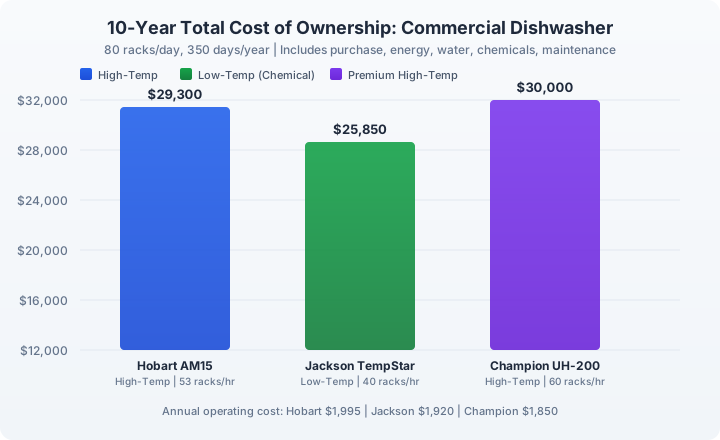
| Annual Operating Cost | $1,995 | $1,840-$2,000 |
| 10-Year TCO | $28,150-$30,450 | $24,200-$27,500 |
The low-temp machine costs $3,000-$4,000 less upfront and saves $155-$465 a year in operating costs. Over 10 years, the low-temp Jackson costs $3,000-$4,000 less total. But there's a catch: low-temp machines run slower cycles. At 80 racks a day, the 30-second difference per cycle adds up to 40 extra minutes of machine time daily. If your dishwasher is already your bottleneck during rush, the high-temp speed matters more than the energy savings.
The Energy Star Difference
Recommended Tool
Shop the largest selection of restaurant equipment at WebstaurantStore.
Free shipping on orders over $99 and price match guarantee.
Energy Star certified commercial dishwashers use 25-40% less energy and 20-30% less water than standard models. The certification isn't marketing. It's a DOE-verified standard that measures idle energy rate, water consumption per rack, and gallons per hour during operation.
An Energy Star high-temp machine uses about 0.9 gallons of water per rack versus 1.2 gallons for a non-certified model. At 80 racks a day, 350 days a year, that's 8,400 gallons saved annually. At $6 per 1,000 gallons (national average commercial water rate), that's $50 a year. Not life-changing. But combined with the energy savings, an Energy Star machine saves $350-$500 a year total.
The real savings come from the idle mode. A standard dishwasher keeps its wash tank at 150 degrees all day, even when nobody's running racks. An Energy Star machine drops to 120 degrees during idle and reheats in 15-20 seconds when you need it. That idle energy reduction saves $180-$280 a year by itself.
Side-by-Side Spec Comparison
| Specification | Hobart AM15 | Jackson TempStar | Champion UH-200 |
|---|---|---|---|
| Type | High-Temp | Low-Temp | High-Temp |
| Energy Star | Yes | Yes | Yes |
| Racks Per Hour | 53 | 40 | 60 |
| Cycle Time | 60 sec | 90 sec | 55 sec |
| Water Per Rack | 0.89 gal | 0.78 gal | 0.74 gal |
| Power Draw | 4.8 kW | 2.1 kW | 4.2 kW |
| Daily Energy (80 racks) | 15.0 kWh | 5.5 kWh | 12.5 kWh |
| Wash Tank Capacity | 14 gal | 12 gal | 16 gal |
| Recovery Time | 45 sec | 60 sec | 35 sec |
| Noise Level | 72 dB | 65 dB | 70 dB |
| Warranty | 1 year | 1 year | 2 years |
| Installed Price | $8,200–$10,500 | $5,800–$7,500 | $10,500–$13,000 |
The Champion delivers the fastest cycle and lowest water consumption but costs $3,000–$5,500 more than the Jackson. The Jackson draws less than half the power of either high-temp machine but runs 30 seconds slower per cycle. At 80 racks a day, that 30-second difference adds 40 minutes of run time, which matters during a dinner rush but not during off-peak cleaning.
How to Estimate Your Annual Dishwasher Utility Costs
Use the formula below to compare annual operating costs across models. Your variables are the machine's power draw, cycle count, water consumption per rack, and local utility rates.
Step 1: Calculate Daily Energy Cost
| Machine | Cycles/Day | kW Rating | Daily kWh | Annual kWh | Annual Cost at $0.14/kWh |
|---|---|---|---|---|---|
| Hobart AM15 | 80 | 4.8 kW | 15.0 kWh | 5,250 kWh | $735 |
| Jackson TempStar | 80 | 2.1 kW | 5.5 kWh | 1,925 kWh | $270 |
| Champion UH-200 | 80 | 4.2 kW | 12.5 kWh | 4,375 kWh | $613 |
Step 2: Calculate Annual Water Cost
Include sewer charges — most municipalities bill sewer at 80–100% of water consumption.
| Machine | Gal/Rack | Annual Gallons | Water Cost at $6/kgal | Sewer at 80% | Total Water+Sewer |
|---|---|---|---|---|---|
| Hobart AM15 | 0.89 | 24,920 gal | $150 | $120 | $270 |
| Jackson TempStar | 0.78 | 21,840 gal | $131 | $105 | $236 |
| Champion UH-200 | 0.74 | 20,720 gal | $124 | $99 | $223 |
Step 3: Add Chemical Cost (Low-Temp Only)
Low-temp machines require chemical sanitizer at $40–$80 per 5-gallon container, lasting 2–3 weeks at 80 cycles/day.
The Jackson TempStar uses roughly 18 containers per year at $60 each: $1,080/year. High-temp machines like the Hobart and Champion have no chemical cost.
Step 4: Total Annual Operating Cost (80 racks/day, 350 days/year)
| Machine | Energy | Water + Sewer | Chemicals | Total Annual |
|---|---|---|---|---|
| Hobart AM15 | $735 | $270 | $0 | $1,005 |
| Jackson TempStar | $270 | $236 | $1,080 | $1,586 |
| Champion UH-200 | $613 | $223 | $0 | $836 |
The Champion UH-200 has the lowest total annual operating cost despite the highest purchase price. The Jackson TempStar's chemical costs erase its energy savings. Over 10 years, the Champion saves $7,500 versus the Jackson in operating costs. If your budget allows the upfront premium, the Champion is the cheapest machine in the long run.
Model Comparison: The Three That Matter
Hobart AM15 (High-Temp, Energy Star)
The industry standard for a reason. The AM15 runs 53 racks per hour with a 60-second cycle. It uses 0.89 gallons per rack and draws 4.8 kW during the rinse cycle. The wash tank holds 14 gallons and the machine recovers in 45 seconds between cycles. Built like a tank. I've seen AM15s from 2003 still running in busy kitchens.
Price: $8,200-$10,500 installed. Annual operating cost: $1,900-$2,100. Best for: high-volume restaurants doing 100+ racks a day where speed matters.
Jackson TempStar (Low-Temp, Energy Star)
The best low-temp option for most restaurants. Runs 40 racks per hour with a 90-second cycle. Uses 0.78 gallons per rack and draws 2.1 kW. The chemical sanitizer system is built in and automatically dispenses. The machine is quieter than the Hobart and easier to service because the panels come off with two screws instead of six.
Price: $5,800-$7,500 installed. Annual operating cost: $1,800-$2,000. Best for: restaurants doing 40-80 racks a day where energy cost matters more than cycle speed.
Champion UH-200 (High-Temp, Energy Star)
The premium option. Runs 60 racks per hour with a 55-second cycle. Uses 0.74 gallons per rack, the lowest water consumption in its class. Draws 4.2 kW. The wash arms are stainless steel instead of plastic, which means they don't warp after 5 years of 180-degree water. The door mechanism is counterbalanced so it doesn't slam.
Price: $10,500-$13,000 installed. Annual operating cost: $1,750-$1,950. Best for: restaurants that plan to be in the same location for 15+ years and want the lowest lifetime cost.
According to the Energy Star Commercial Dishwashers program, certified models save an average of $1,500 annually in energy and water costs compared to standard models. Hobart has manufactured commercial dishwashers since 1897 and their AM series is the most widely deployed warewasher in North American restaurants. All three models above are NSF-certified for commercial foodservice sanitation standards.
The Water Cost Nobody Calculates
Commercial dishwashers use 150,000-250,000 gallons of water a year. At $6 per 1,000 gallons, that's $900-$1,500. But water cost varies wildly by location. In Phoenix, commercial water is $4.20 per 1,000 gallons. In San Francisco, it's $12.80. In Atlanta, it's $7.60.
A low-temp Energy Star machine in San Francisco saves 35,000 gallons a year versus a standard high-temp machine. That's $448 a year in water alone. In Phoenix, the same savings is $147. The water math changes your equipment decision depending on where you are.
Also factor in sewer charges. Most municipalities charge sewer based on water consumption. If your water bill is $900 and your sewer charge is 80% of water, you're paying $720 in sewer on top of the water. The 35,000-gallon savings is actually worth $448 in water plus $358 in sewer. Total: $806 a year in San Francisco.
My Recommendation
For most independent restaurants doing 40-80 racks a day, buy the Jackson TempStar low-temp Energy Star model. It costs $3,000-$4,000 less upfront than a Hobart, saves $150-$400 a year in operating costs, and the slower cycle time won't bottleneck your dish pit unless you're doing 100+ racks during a 3-hour rush.
For high-volume restaurants doing 100+ racks a day, buy the Hobart AM15. The speed matters more than the energy savings. A 30-second faster cycle at 100 racks a day saves 50 minutes of machine time. Your dishwasher goes home 50 minutes earlier. At $18/hour, that's $15 a day in labor savings. Over a year, $5,250. The labor savings dwarf the energy difference.
For restaurants in high water-cost areas (California, Northeast), the low-temp Energy Star models pay for themselves fastest. The water savings alone cover the price difference in 3-4 years.
Before you buy, check your commercial dishwasher buying guide for installation requirements. Dishwashers need dedicated electrical circuits, floor drains, and sometimes a booster heater. The installation can cost $2,000-$4,000 on top of the machine price. Run your equipment budget through our restaurant startup costs calculator. For kitchen layout planning, see our restaurant floor plan guide. Use our restaurant ROI calculator to compare the payback period of each model.
A Warning About Low-Temp Dishwasher Bottlenecks
A restaurant in Denver bought a low-temp Jackson TempStar to save $3,000 upfront and $400 a year in energy costs. It was the right financial call on paper. The problem: the 90-second cycle couldn't keep up with their 140-rack Saturday nights. Dishes piled up. Servers started hand-washing glassware to get it back on the floor during the rush. The hand-washing added 20 minutes of labor per server per shift. At 6 servers making $14 an hour, that's $28 a night in extra labor. Over 52 Saturdays, $1,456. The owner switched to a high-temp Hobart 6 months later. He took a $3,200 loss on the Jackson resale.
The cycle speed matters as much as the energy cost. If your dish pit is the bottleneck during peak, a slow machine costs you more in labor and frustration than it saves in utilities.
FAQ
How much electricity does a commercial dishwasher use?
A high-temp Energy Star dishwasher uses 12-18 kWh per day at 80 cycles. A low-temp Energy Star model uses 4-7 kWh. At the national average commercial rate of $0.14/kWh, that's $1.68-$2.52 per day for high-temp and $0.56-$0.98 for low-temp.
What's the difference between high-temp and low-temp commercial dishwashers?
High-temp machines sanitize with 180-degree water and a built-in heating element. Low-temp machines sanitize with chemical sanitizer at 120-140 degrees. High-temp costs more to buy and operate but runs faster cycles. Low-temp costs less upfront and uses less energy but requires ongoing chemical purchases.
Is an Energy Star commercial dishwasher worth it?
Yes. An Energy Star certified dishwasher saves $350-$500 a year in combined energy and water costs versus a standard model. Over a 10-year lifespan, that's $3,500-$5,000. The price premium for Energy Star is typically $800-$1,500, so the payback period is 2-3 years.
How much water does a commercial dishwasher use?
An Energy Star commercial dishwasher uses 0.74-0.89 gallons per rack. A standard model uses 1.0-1.3 gallons. At 80 racks a day, 350 days a year, the difference is 7,300-14,600 gallons annually.
Which brand of commercial dishwasher is most reliable?
Hobart is the industry standard for reliability. Their AM series machines routinely last 15-20 years with proper maintenance. Jackson is a close second at a lower price point. Champion costs more but offers the lowest water consumption and longest warranty.
Recommended Tool
Equip your restaurant with WebstaurantStore.
The #1 supplier for restaurant equipment and supplies.