
A restaurant owner in Las Vegas called me about his electric bill in July. His monthly bill had hit $3,400 for his 2,800-square-foot restaurant. He asked me to look at his equipment. His Manitowoc ice machine was a 2014 model producing 450 pounds of ice a day. It drew 5.8 kW and ran 16 hours a day in the Vegas summer heat. That's 92.8 kWh a day. At Nevada's commercial rate of $0.11/kWh, $10.21 a day. $306 a month. $3,672 a year. Just for ice.
A new Energy Star Hoshizaki producing the same 450 pounds a day draws 4.1 kW. At 16 hours a day, 65.6 kWh. $7.22 a day. $216 a month. $2,598 a year. The new machine saves $1,074 a year in electricity. It costs $3,800. The energy savings alone pay for it in 3.5 years. The old machine was costing him more to operate than a new machine costs to buy.
Ice machines are the sneaky energy hogs of commercial kitchens. They run constantly. They generate heat that your AC has to fight. They use water for both ice production and condenser cooling. The purchase price is maybe 40% of the total cost of ownership. Here's the math.
The Three Costs of Ice
Electricity. An ice machine runs 14-18 hours a day depending on ambient temperature. A 500-pound air-cooled machine draws 4-6 kW while running. At 16 hours a day and $0.12/kWh (national average commercial rate), that's $7.68-$11.52 a day. $2,803-$4,205 a year.
Water. An ice machine uses water to make ice and water to cool the condenser. An air-cooled machine uses 15-25 gallons of water per 100 pounds of ice. A water-cooled machine uses 100-150 gallons per 100 pounds because it runs water continuously over the condenser. At 500 pounds a day, an air-cooled machine uses 75-125 gallons. A water-cooled machine uses 500-750 gallons. At $6 per 1,000 gallons, that's $0.45-$0.75 a day for air-cooled versus $3-$4.50 a day for water-cooled. Over a year, $164-$274 versus $1,095-$1,643.
Maintenance. Ice machines need quarterly cleaning and sanitizing. A service call costs $150-$250. Four times a year: $600-$1,000. Plus descaling every 6-12 months depending on water hardness: $200-$400 per treatment. Annual maintenance: $1,000-$1,800.
Total annual operating cost for a 500-pound air-cooled ice machine: $3,967-$6,279. The purchase price of $3,000-$5,000 is roughly equal to one year of operating costs.
Air-Cooled vs Water-Cooled: The Real Difference
Recommended Tool
Shop the largest selection of restaurant equipment at WebstaurantStore.
Free shipping on orders over $99 and price match guarantee.
Air-cooled machines use a fan to blow air across the condenser. They're simpler, cheaper to install, and use less water. They're also louder and dump hot air into your kitchen. In a 100-degree kitchen, an air-cooled machine struggles. Production drops 20-30%. Energy use increases 15-25%.
Water-cooled machines run water over the condenser and down the drain. They're quieter, more efficient in hot environments, and maintain production regardless of kitchen temperature. They also use 5-7 times more water. In a city with high water rates, a water-cooled machine can cost more to operate than an air-cooled machine despite using less electricity.
| Air-Cooled (Manitowoc IY-0500A) | Water-Cooled (Manitowoc IY-0500W) | |
|---|---|---|
| Purchase Price | $3,400-$4,200 | $3,800-$4,600 |
| Daily Energy Use | 78 kWh | 62 kWh |
| Annual Energy Cost | $3,416 | $2,716 |
| Daily Water Use | 100 gal | 600 gal |
| Annual Water Cost | $219 | $1,314 |
| Annual Maintenance | $1,200 | $1,400 |
| Total Annual Operating Cost | $4,835 | $5,430 |
| 5-Year TCO | $27,575-$28,375 | $30,950-$31,750 |
The air-cooled machine costs $600 more in electricity but $1,095 less in water. Net: air-cooled is $495 a year cheaper to operate. Over 5 years, $2,475 cheaper. The water-cooled machine only wins if your kitchen is consistently above 95 degrees and the air-cooled machine's production drops below what you need.
How to Estimate Your Annual Ice Machine Utility Costs
Use the four-step formula below to calculate your expected annual operating cost for any machine. You only need three numbers: the machine's kW rating, your daily runtime, and your local utility rates.
Step 1: Calculate Daily and Annual Energy Use
| Machine | kW Rating | Daily Runtime | Daily kWh | Annual kWh | Annual Cost at $0.12/kWh |
|---|---|---|---|---|---|
| Manitowoc IY-0500A | 5.2 kW | 16 hrs | 83.2 kWh | 30,368 kWh | $3,644 |
| Hoshizaki KM-520MAJ | 4.1 kW | 16 hrs | 65.6 kWh | 23,944 kWh | $2,873 |
| Scotsman C0530SA-1A | 4.8 kW | 16 hrs | 76.8 kWh | 28,032 kWh | $3,364 |
The Hoshizaki saves $771 a year in electricity versus the Manitowoc at average commercial rates. If your local rate is higher (California averages $0.18/kWh), the gap widens to $1,156.
Step 2: Calculate Water Cost
| Machine | Water per 100 lbs | Daily at 500 lbs | Annual Gallons | Annual Cost at $6/1,000 gal |
|---|---|---|---|---|
| Manitowoc IY-0500A | 20 gal | 100 gal | 36,500 gal | $219 |
| Hoshizaki KM-520MAJ | 18 gal | 90 gal | 32,850 gal | $197 |
| Scotsman C0530SA-1A | 22 gal | 110 gal | 40,150 gal | $241 |
Step 3: Calculate Maintenance Cost
Quarterly cleaning plus annual descaling:
Most operators budget $1,000–$1,800 per year depending on water hardness and local service rates. Hard water areas need more frequent descaling, which adds $200–$400 per treatment.
Step 4: Total Annual Operating Cost
| Machine | Energy | Water | Maintenance | Total Annual | 5-Year Total |
|---|---|---|---|---|---|
| Manitowoc IY-0500A | $3,644 | $219 | $1,200 | $5,063 | $25,315 |
| Hoshizaki KM-520MAJ | $2,873 | $197 | $1,200 | $4,270 | $21,350 |
| Scotsman C0530SA-1A | $3,364 | $241 | $1,200 | $4,805 | $24,025 |
The Hoshizaki saves $793 a year versus the Manitowoc — $3,965 over 5 years. That nearly covers the purchase price of a new machine. To estimate your own cost: check your machine's data plate for the kW rating, measure your actual daily runtime with a kill-a-watt meter or estimate based on 14–18 hours, and look up your commercial electricity rate on your utility bill.
The Brand Comparison
| Manitowoc IY-0500A | Hoshizaki KM-520MAJ | Scotsman C0530SA-1A | |
|---|---|---|---|
| Daily Production | 470 lbs | 490 lbs | 500 lbs |
| Energy Use | 5.2 kW | 4.1 kW | 4.8 kW |
| Annual Energy Cost | $3,416 | $2,693 | $3,153 |
| Water Use per 100 lbs | 20 gal | 18 gal | 22 gal |
| Annual Water Cost | $219 | $197 | $241 |
| Purchase Price | $3,400-$4,200 | $3,600-$4,400 | $3,200-$4,000 |
| Warranty | 3 years | 3 years | 3 years |
| Noise Level | 68 dB | 62 dB | 70 dB |
| Best For | Hot kitchens | Energy efficiency | Budget buyers |
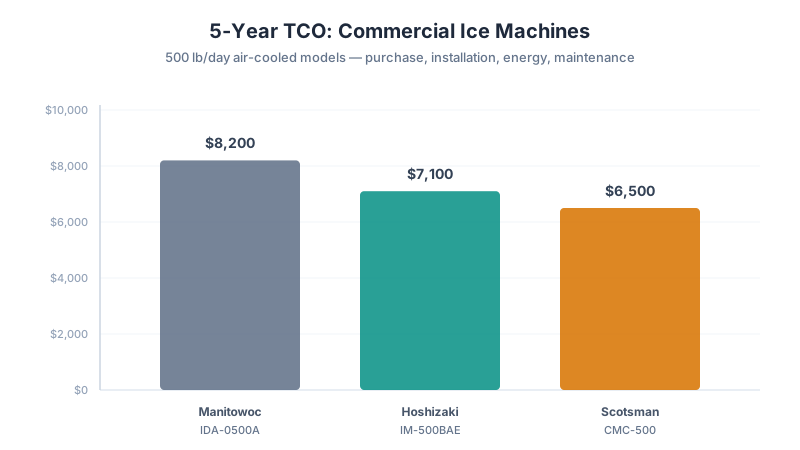
All three brands are Energy Star certified and NSF-certified for commercial foodservice sanitation. Hoshizaki manufactures their KM series in Georgia and is the most energy-efficient option, using 21% less electricity than comparable Manitowoc models. Manitowoc Ice has the largest service network in North America with parts available same-day in most cities. Scotsman offers the lowest upfront cost with competitive reliability. According to the DOE Commercial Ice Maker standards, new federal efficiency standards effective 2025 require all commercial ice machines to meet stricter energy and water consumption limits.
The Sizing Mistake
Most restaurants buy ice machines that are too big. The rule of thumb is 1.5 pounds of ice per customer per day. A restaurant serving 200 covers a day needs 300 pounds of ice production. But that rule assumes every customer gets a full glass of ice. In reality, water drinkers get ice. Wine drinkers don't. Beer drinkers don't. Coffee drinkers don't.
A better formula: count your water, soda, and iced tea servings. Multiply by 0.5 pounds per serving. Add 20% for the ice bin (ice melts, you need buffer). A restaurant serving 80 sodas, 40 waters, and 30 iced teas a day needs (150 × 0.5) × 1.2 = 90 pounds of daily ice production. A 200-pound machine is more than enough. A 500-pound machine is wasting $1,500-$2,500 a year in unnecessary energy and water.
I've seen a restaurant with a 600-pound Hoshizaki that never produced more than 200 pounds in a day. The owner bought it because "bigger is better." He spent an extra $1,800 on the machine and $2,100 a year in extra operating costs for ice he never used. Over 8 years, $18,600 wasted.
My Recommendation
Buy Hoshizaki if energy cost is your primary concern. The KM-520MAJ uses 21% less electricity than the Manitowoc equivalent. The $723 annual savings compounds over the machine's 10-year lifespan. The reliability is excellent. The noise level is the lowest of the three.
Buy Manitowoc if serviceability is your primary concern. Every tech knows Manitowoc. Parts are available same-day in most cities. The machine is slightly less efficient but slightly more reliable. For a restaurant in a smaller city where Hoshizaki parts might take 2-3 days, Manitowoc is the safer choice.
Buy air-cooled unless your kitchen consistently exceeds 95 degrees. The water savings outweigh the electricity penalty in almost every market. Water-cooled only makes sense in extremely hot kitchens or where water is unusually cheap.
Size your machine correctly. Measure your actual ice usage for a week before buying. Don't guess. Don't use the 1.5-pounds-per-customer rule. Count your ice-dependent drinks and do the math.
For more equipment guidance, see our commercial ice machine buying guide and our commercial refrigerator guide. Run your equipment costs through our restaurant break-even calculator. For kitchen equipment placement, see our restaurant floor plan guide.
A Warning About Oversizing Your Ice Machine
A restaurant in Atlanta bought a 600-pound Scotsman ice machine because the previous owner told them "you can never have too much ice." The restaurant used about 120 pounds a day. The 600-pound machine ran for 3 hours, filled the bin, and shut off. Then the ice melted. The machine turned back on. Filled the bin. Ice melted again. On a hot day, the machine cycled 8 to 10 times, each cycle drawing 4.8 kW and dumping hot air into the kitchen that the AC had to fight. The owner's utility bill was $340 a month higher than a neighboring restaurant with the same square footage and volume. A properly sized 200-pound machine would have cost $1,200 less to buy and $2,880 less per year to operate. The oversizing mistake cost more than the machine itself every 18 months.
Measure your actual ice usage for a week before you buy. The 1.5-pounds-per-customer rule overestimates by 40-60%. Buy the machine that fits your real demand, not your ego.
FAQ
How much electricity does a commercial ice machine use?
A 500-pound air-cooled ice machine uses 65-93 kWh per day depending on the brand and ambient temperature. At $0.12/kWh, that's $7.80-$11.16 a day. $2,847-$4,073 a year. Energy Star models use 15-25% less.
What's the difference between air-cooled and water-cooled ice machines?
Air-cooled machines use a fan to cool the condenser. They use less water but more electricity and are louder. Water-cooled machines run water over the condenser. They use 5-7 times more water but less electricity and are quieter. Air-cooled is cheaper to operate in most markets.
How much water does a commercial ice machine use?
An air-cooled machine uses 15-25 gallons per 100 pounds of ice. A water-cooled machine uses 100-150 gallons per 100 pounds. At 500 pounds a day, that's 75-125 gallons for air-cooled versus 500-750 gallons for water-cooled.
Which brand of ice machine is most energy-efficient?
Hoshizaki. The KM-520MAJ uses 4.1 kW versus Manitowoc's 5.2 kW and Scotsman's 4.8 kW for comparable 500-pound machines. The annual energy savings are $500-$800 depending on local electricity rates.
How do I size a commercial ice machine for my restaurant?
Count your daily water, soda, and iced tea servings. Multiply by 0.5 pounds per serving. Add 20% buffer for ice melt. A restaurant serving 150 ice-dependent drinks a day needs about 90 pounds of daily production. Don't use the 1.5-pounds-per-customer rule. It overestimates by 40-60%.
Recommended Tool
Equip your restaurant with WebstaurantStore.
The #1 supplier for restaurant equipment and supplies.